Immersive Experience

I’m at the beach, looking out at the ocean. As my mom pointed out, the horizon line is choppy and each wave is being attacked ferociously by the wind, causing a thick fan of mist to spray from it.

This morning, inspired by the rhythm and beauty of the sea, we talked about moments in life that become preserved (perfectly?) in our memories. Of course as mother and daughter we had some shared moments to talk about – and also some individual ones. I told mom about a moment I shared with a friend of mine on a backpacking trip, when we rushed to the tip-top of a peak called ‘Shining Rock,’ with just too little time before the sunset to search for and find out cameras in our wet packs. When we hit the crest of the mountain and emerged onto the quartz outcrop, the sun was breaking through the clouds in an array of colors and beams that took our breath away. It reminded me of the ocean in a way – like seeing underneath the water. The clouds set a soft horizon line over the expanse of blue ridges.

There was a moment in this moment when we both were exasperated by our lack of picture-taking devices – but then came the freedom. When ‘preservation’ with a camera is possible it’s hard to resist the fantasy that holding on to these moments in our lives is possible (oops, I guess this is a continuation of my explication on change). When preservation is impossible, say we don’t have cameras and we left our phones locked up in the car, immersion becomes possible. What are the ingredients of immersion? Dedication, curiosity, gratitude? I don’t know. I would say though, that those moments in life that we can never forget, are most likely ones in which we were not concerned with holding on.

Everything in life I ever needed to know…

“I decided many years ago that a high blood sugar does not define me any more than a great blood sugar defines me. For 42 years I have been chasing the perfect blood sugar. It has never happened for more than a minute just the same as the really high ones do not last any longer.”

– Rick Phillips

I want to give a shout out to change. Year after year, change has stood by me. More than that, change even visits me day to day and moment to moment. So here’s to change: a truly dedicated friend.

Obviously, I also want to give a shout out to Rick Phillips, whose response to last week’s question is today’s featured quote. A big thanks to everyone who responded and added to our conversation around high-blood sugar blues and how to pick yourself up from them. Rick’s quote jumped out at me because of its utility for maintaining perspective as we manage (versus ‘control’) blood sugar and also as we manage (versus ‘control’) life. Last week I was talking to a fellow graduate student, job seeker and swimmer in the sea of uncertainty at a social for public healthers in my program. She mentioned that it’s taken her a year and a half to feel like she’s truly gotten her footing here and now it may be time to shift everything once again, perhaps even in a totally new place. I thought of Rick’s quote – how many ladders of learning and accomplishments and life experiences do we climb up, only to reach the end and realize we’ve moved not to a new plateau of constancy, but simply on to the next challenge? That sounds a little pessimistic I think, but it’s not intended to. Blood sugar management from the accept and let go perspective can sound a little pessimistic to – like, no matter how hard I try, even if I check my blood sugar and get that magic 90 mg/dl, it’s already changing, I can’t hold on to it. But! BUT! In truth, this is a comfort too. This wisdom of letting go is so helpful in diabetes and in life, because it directs us back to the process, not the product.

I think I’d like to make one of those posters like you see on the wall of dentist’s offices: ‘Everything in life I need to know I learned in kindergarten,’ except it would say: ‘Everything in life I need to know I learned from diabetes.’ That’s a little over-simplified though. In truth, not knowing has led me towards these conversations with friends and others that help me to break free from dichotomous thinking and see that there are ways of seeing and thinking about challenges that I have not even considered yet, which is itself a comforting thought.

So change, you may be a wildcard, the guest who comes to the party in sequins, carrying a jello-cake and two days early – but, you might as well come in.

Calling all people with diabetes!

Community Discussion: High Blood Sugar (hyperglycemia)

How do you pick yourself back up emotionally when you have a high blood sugar reading that frustrates you? Please weigh in in the comment section below! I think we could generate some good wisdom amongst ourselves!

Oh, and if you don’t have diabetes, please share this link/blog with someone who does…I know you know someone who does. I’m really hoping to build this community and you are an important part of that effort!

Interdependence

This is the English version, slightly adapted to the current moment, of my last post from Sunday.

There’s a lot I could write about, but I’d like to start with a discussion about the word ‘neighbor.’ This word has entered my mind and my world a lot lately, and I’m thinking about what it means to be a good neighbor. Another word that has appeared again and again is ‘community.’ I went to a community this past weekend where it is evident that there is this idea of living, in the words of one resident, “in an interdependent way.” It is, she says, an alternative to living so independently, without recognizing that we do depend on each other. Why is it so hard in our culture (in all cultures?? in some more than others??) to accept help? I think that it’s a function of our perceptions about the relationship between ourselves and others, or saying it another way, between our inner world and our outer world.

It’s here that I’ll bring diabetes into the conversation (did you know that everything relates to diabetes?). A week ago I fell down the stairs (or more like I fell on the stairs while going down them). When I fell, it scared the woman who was climbing up from the other direction and she gasped and grabbed her heart. For a moment she looked worse than me. It was captivating to me that my movements and an action occurring to my body could move her too – that we were connected in this way. Later, in dance class with my leg hurting badly, I realized that my blood sugar was very low and that maybe that was why I had fallen. The level of sugar (glucose, officially) inside my body influences my movements in the world. This is a perfect metaphor for the influence that we have on our surroundings. Our thoughts, beliefs, prejudices, and personal histories have an impact on our environment whether we like it or not. We are connected. We can only operate in the world without recognizing that we depend on each other while we maintain power, or rather, until we lose control. For me, when I fell I lost control. It was a humbling experience that temporarily transformed my body. We’re always talking about shoes, but this journey taught me that a novel way to experience empathy is to imagine what life would be like in another body. Empathy is the key (for me) to being a good neighbor. Obviously, there is another moral here too for my friends who have Type 1 diabetes (or Type 2 for that matter), that is, please check your blood sugars regularly and be careful when you’re having a low.

Today my leg is feeling much better (I danced – joyously, today), and once again I’m thinking about how we can use the word gratitude as a verb. If our heart is struggling to let empathy in, maybe gratitude can help us tear down the wall.  

¿Por qué bailar solo?

Hay mucho sobre que pudiera escribir, pero quiero empezar con una discusión sobre la palabra ‘prójimo.’ Esta palabra ha entrado mi mente y mi mundo mucho recientemente, y estoy pensando en lo que significa ser una buena prójima. Otra palabra que ha entrado es comunidad. Fui a una comunidad ayer adonde es evidente que hay esta idea de vivir, en las palabras de una residente, “de una manera interdependiente.” Es, dice ella, una alternativa de vivir tan independiente, sin reconocer que somos dependientes el uno del otro. Por qué es tan dificil en nuestra cultura (en todas las culturas?? Algunas más que otras??) a aceptar que no podemos hacer todo por nuestra cuenta. Por qué se da tan mucho miedo ser vulnerable y aceptar ayuda? Pienso que es una funciona de nuestras percepciones sobre la relaciona entre nosotros y los demás, o sea, entre nuestro mundo interior y mundo exterior. Es aquí adonde traeré diabetes entra la conversación. Está semana me caí por las escaleras. Le di un asusto a la mujer que estaba subiendo desde la otra dirección. Fue interesante que mis movimientos y la acción a mi cuerpo podría moverla también – que estábamos conectadas en esta manera. Luego, en mi clase de bailar con mi pierna doliendo mal, me di cuenta que mi azúcar fue muy bajo y que posiblemente era por eso que caí. El nivel de azúcar dentro de mi cuerpo influye mis movimientos en el mundo. Esta es una metáfora perfecta para la influencia que tenemos en nuestros aldrededores. Nuestros pensamientos, creencias, prejuicios, y historias personales tienen un impacto en el exterior sin nos guste o no. Somos conectados. Solo podemos operar en el mundo sin reconocer que dependemos de otros mientras tenemos poder, o sea, hasta que perdemos el control. Para mi, cuando me caí, perdí control. Fue una experiencia humillando, que me transformó en otro cuerpo temporalmente. Este viaje, pienso que es valioso, porque permite empatía. Esto, empatía, pienso que es el ingrediente clave (para mi) de ser una buena prójima. Obviamente, hay otra moral aquí también para mis amigos que tienen diabetes tipo 1 (o 2 realmente), que es, por favor, mide tus niveles de azúcar frequentemente y cuídate cuando tienen bajos. Ahora mi pierna se siente mucho mejor y estoy otra vez pensando en como podemos usar la palabra gratitud como un verbo. Tal vez, si estamos luchando por encontrar empatía, podemos pensar en todas las cosas en nuestras vidas por lo que deberíamos tener gratitud.

CHOCOLATE RULES!

It’s Valentine’s Day.

But who needs an excuse to eat chocolate?

If you know me, you know that I carry dark chocolate with me almost everywhere I go. It’s not that I’m always eating chocolate, it’s just that when I need chocolate, I have it on hand. I also almost always have an apple on hand, but that’s an aside. I say this to establish myself as an authority on chocolate, before offering up the following,

Chocolate Rules:

***BIG GIANT DISCLAIMER: I am not a nutritionist, dietitian, or otherwise ‘health expert,’and I do not aim to offer advice, only to share my experiences.

  1. Because I’m always thinking about blood sugar, I choose dark chocolate. Typically it has less sugar and carbohydrates per serving than milk choc., may even contain some fiber, and hip health gurus say (and this is true) that dark chocolate is ‘packed’ with antioxidants (although did you know that the largest single source of antioxidants in the American diet as a whole is coffee???).
  2. So what’s a portion? I think it’s important to look at the nutrition label and decide for oneself. You’ll notice that the portion size listed on a label might contain upwards of 20 grams of carbs. For me, that’s often more than I want to get from chocolate alone. The amount of chocolate I eat at one time depends on so many factors, from what my blood sugar is, to how much insulin I’ve taken, to if I’m going for a walk or to bed. A good rule of thumb that I use is the ‘rule of thumb’. If you notice, your thumb is about the size of 2 blocks of dark chocolate – perfect!
  3. Managing portion size is a great way to afford the dark chocolate habit – Dark chocolate can be expensive! Trader Joe’s typically has some cheaper varieties, but I also browse for sales. At any given time there’s usually a delicious bar on a pretty good sale, which feeds well into…
  4. Variety is key!
  5. Sharing is essential – Dark chocolate is meant for sharing. It’s a great thing to pass around, it’s perforated as if sharing was built into the bar, it makes people smile, and it can really make a meeting feel more like a party.
  6. And shouldn’t life be more like a continual party?

Having diabetes doesn’t mean that a person can’t eat sweets and still be healthy, but it does mean that they need to be really thoughtful about the sweets they choose, how often they eat them, and in what portions.

For me, two squares of dark chocolate is the perfect fix – the period on the end of a meal.

Right now I’m starry-eyed over Chocolove’s Salted Almond Butter Variety, but one of my long time and more artsy favorites is Endangered Species’ Blackberry Sage Variety. The featured image shows my full collection, which rotates regularly.

Thanks for sharing your recommendations with me below – I’m always eager to try something new!

The Story Begins

Epilogue

If you missed Chapters 1 – 3, which precede this post, you can find them here:

You’re Never Gonna Make It

With a Minute to Spare

The Plane is Coming Back?

And in case you’re wondering, “How long can she drag this story out?” I guarantee you that this is the last in the series about getting on the plane, but I had left the moral of the story untouched, or at least inexplicit, if there is one at all.

None of this was clear to me while I was writing the story, but I realized that during the whole journey from NC to Bolivia, I was balancing two contradictory emotions: panic and trust. Is trust an emotion? For me, at the time, it was. It was a force I could call on, not from outside of myself, but not just from inside of myself either. I would like to say I knew all along that it would work out, somehow, miraculously, meaning some fluke would allow me to defy the odds and make it on my flight, but really, I think I just knew that it would all work out even if I missed my flight and ended up stuck.

How nice that I have that security, even if sometimes it might be misguided. How lucky I am, truly lucky, to be able to have faith in humanity and in individuals, to help me if I am in a bind.

Here’s the thing about the panic: I could have skipped it. I could have proceeded with my plan, read SkyMag on the short flight to Miami, leisurely strolled down the deserted aisles, and arrived at my gate, right as the woman on the intercom was calling us over to let us know that the plane was re-docking.

I’m not advocating for panic. And since this experience, I’ve learned how to calm it down, and reassure myself in the moment that if I am feeling that trust, I can lean on it, and know that even if it doesn’t go according to plan, I’ll be able to make it work. But yet at the same time, emotions overtake us and sometimes hold on with a fierce grip. I didn’t breathe until I got on the cart with Jose and as we were racing, so to speak, towards the gate, I felt that people really wanted to help me, that I wasn’t alone.

With each kindness my panic subsided a little bit more and the glowing warmth of trust that I felt grew bigger. My path was validated by each point at which it seemed unfeasible.

On the plane, making my way to my seat, all emotions stepped aside so that I could experience pure elation (and exhaustion), which I have to say is one of my favorite states to be in. When I found my row, a man sitting by the aisle got up, looked at me quizzically, like, “Where did you come from?” and then let me pass. I flopped down in my window seat. He turned to me and said, “Are you just now getting on the plane.” “Yeah!” I said and smiled. “Yeah, it came back for me. No I mean, there’s technical difficulties I guess, but I missed it, and it came back.” “Wow, you’re the only person who’s happy about this” (talking about the tech issues, which at this point we had been informed were being addressed). I just laughed. Usually I would have explained but I didn’t even really understand what had happened. So we just talked about the plans we had for our trips and our work and lives back in the US. This person would become a friend who I would run into, by chance, two more times during the course of my trip.

The story didn’t end when I got on the plane; really that’s just where it began. Looking back, it seems like the interdependent lucky breaks that I caught were tailored to fit together in one precise pattern, like a code to crack. In truth, I suspect other versions of the story that would exist had one thing been different, would also have been rich and meaningful. But the blessed nature of my departure and take-off carried me through the challenges of travel, and reminded me that I was on the right path.

We all, each day, comprise the narrative of each other’s lives and write our stories together. Today I’m thinking about how we are a community even as we are strangers. Today I’m thinking about how the difference between apathy and compassion sometimes lies in simply looking people in their eyes.  Today I’m remembering the power of helping someone get where they need to go.


Saying Goodbye to Mary Tyler Moore: a Member of Our T1D Community

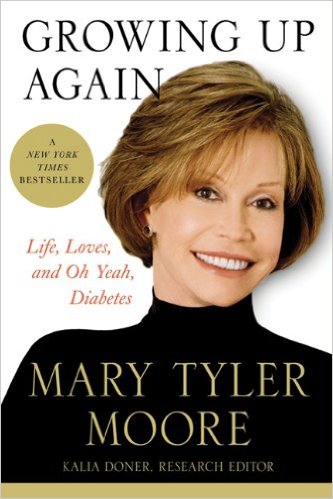
Yesterday the Type 1 Diabetes community said goodbye to Mary Tyler Moore. The New York Times talks about Moore as a “feminist icon” in her role on the Mary Tyler Moore show and NPR discusses her comedy and wit. America knew Mary Tyler Moore for all of these things, along with her beauty and charm, but many may not know that she did it all while managing Type 1 Diabetes. In fact, she was diagnosed in her early 30’s, shortly before the Mary Tyler Moore Show first aired.  In her book, Growing Up Again, she details her journey with Type 1 Diabetes from diagnosis, to becoming a champion and funder for diabetes research. I found the book approachable and inspiring, and recommend it especially for those diagnosed in late teens or early adulthood. I want to offer a quote from Chapter 3, because it resonates with the pain I felt when I was diagnosed so clearly:

“Spontaneity is one of the first of life’s pleasures that’s lost when diabetes appears. Everything must be thought out carefully before doing almost anything. No one likes to give up any sort of freedom, but when dealing with diabetes, there are some things one must accept. This and other matters fall under the heading of control. If you don’t control diabetes, it will control you.”

In this quote I think we see the Mary Tyler Moore spirit that viewers loved her for; the feisty, playful nature, coupled with the acceptance of a life-changing condition. And yet, despite all that careful thinking, Moore did so much in her lifetime, including advocating for others living with T1D, as covered by USA Today.

I’m moved by her story because she’s celebrated as a woman who accomplished so much, and yet all the while she had the full-time job of diabetes to attend to behind the scenes. I’m so grateful that Mary Tyler Moore decided to share this part of herself, her diabetes story, with the world, and give her inspiration to our T1D community.

References:

Moore, T. M. (2009). Growing Up Again: Life, Loves, and Oh Yeah, Diabetes. New York, NY: St. Martin’s Press.

Painter, K. (2017, January 25). Mary Tyler Moore was a role model for others with type 1 diabetes. USA Today, News. Retrieved from http://www.usatoday.com/story/news/2017/01/25/mary-tyler-moore-type-1-diabetes/97058152/

Baker, J. (2017, January 25). She turned the world on with her smile: Mary Tyler Moore dies at 80. NPR: All Things Considered. Retrieved from  http://www.npr.org/sections/thetwo-way/2017/01/25/461947952/she-turned-the-world-on-with-her-smile-mary-tyler-moore-dies-at-80

Heffernan, V. (2017, January 25). Mary Tyler Moore, who incarnated the modern woman on TV, dies at 80. The New York Times, Television. Retrieved from https://www.nytimes.com/2017/01/25/arts/television/mary-tyler-moore-dead.html?_r=1

The Plane is Coming Back?

First, I want to recognize MLK Day and my gratitude for a day of remembrance, action, and unity.

Chapter 3

“I’m here! I’m here!” I shouted as I leapt off the airport go-cart.

“Hi, hi, I’ve got to get on the plane, I’m the last passenger” (I’m not sure when I decided this fact), I said as I stumbled over to the airport boarding and security person, my backpack flopping to and fro.

“Goodbye Jorge! Thank you!” I turned and yelled to my friend who shook his head at me and motored the cart a few feet away.

“You’re too late. The plane is gone. Nothing we can do.”

The airport guard said all these statements in a rapid montage that I like to call, ‘The most painful one-liners a hopeful traveler can hear.’ It was as if he’d practiced the exact combination of phrases that would shut down all hopes the quickest.

I was crushed, like a peanut shell on the sidewalk. Yet, shockingly, I remained undeterred by this obstacle. Somehow, the run had made me confident in my choice to get on the plane to Miami and embark on the first leg of my journey. The adrenaline coursing through my veins made me feel like I was in the sort of adventure where the protagonist overcomes incredible odds and ultimately completes her goal.

I said, “Nooo!”

He said, “Yes.”

I said, “I have to get on that plane. I have to go to BOLIVIA!”

“I said there is nothing we can do. The gate is closed. The plane has left. You were too late.”

At the repetition of those words I was filled with shame. I had let the plane go by. I was too late.

The moment passed and I decided to try arguing again.

“But I can see it! I know it’s there. I can see the plane!” I exclaimed, pointing out a foggy wall-length window.

“This is an airport. That’s not your plane.”

I realized then, the flaw in my argument. I realized too, how fixated I had become on this goal, as if it were the only way that my plans, my life, could work out.

I began to sob. Heaving sobs. I think it was that I hadn’t been able to really breathe for some time now. That and, up until this man, everyone else had been SO supportive, as if they were sent to help me along on my journey. Now suddenly it felt as if he’d slapped me in the face with a wet fish of reality (just trying that metaphor out).

“Stop crying. You don’t need to cry. People miss their flights every day. It’s not like somebody died, you just have to go over there and rebook your flight.”

Now this struck me as simultaneously cruel and also useful. He had reframed what was a complete disaster, to me, as a normal, everyday ‘oops’ from which there was a recovery protocol. And it was, right over there, at a counter where I noticed a little more than a dozen other passengers talking anxiously among themselves.

I looked back at him. “I do need to cry. I appreciate what you’re saying, and I’ll go to do that, but first, I just need to cry for a second.”

At this I saw his eyes soften, almost imperceptibly, but it was there. He walked away as I exhausted the rest of my adrenaline, still strapped to my backpack in one of those little hard blue chairs. I looked over to see Jorge, staring at me with sympathy in his eyes from the other side of the hall.

I thought about going in search of food, or to make some calls, or something before jumping right back into the mess that I’d created. But instead, after a few minutes, I got up, blew my nose (and then washed my hands because I was in an airport and that’s the right thing to do), and walked over to the ticket counter. I was in line behind a beautiful couple who were holding what appeared to be a wrapped painting as their only carry-on. I sniffled as I listened to the conversations around me in Spanish and tried to contact my friend in Bolivia (who I actually hadn’t met in person yet) through Whats App.

Lo perdí (el avion)…voy a ver que pueda hacer ahora. Hay muchos aqui que perdieron.’

She replied: ‘Que pena.’ I agreed.

Estoy en Miami. No se adonde esta mi otra maleta…’

‘Que complicada – no creo que puedas viajar hoy en Bolivia.’

The other problem was that my friend was flying from her hometown to the capitol, La Paz, to meet me. She would have been on the verge of going to sleep to wake up just a few short hours later for an early morning flight. And by early, I mean 3 am.

‘Estoy en la linea para hacer otro vuelo, pero no pienso que puedo volar hasta manana.’ – 10:33 pm

I heard another Whats App message come in from her, but I was too distracted by the sound of an airline employee speaking into her walkie-talkie: “What? What about the plane? Pasajeros a La Paz! Passengers going to La Paz! Passengers going to La Paz, come over here.”

That was me! I ducked under the stretchy cord that was creating our queue, got stuck because of my backpack, fell to my knees and crawled, heaved myself up, and made it to her, right behind the elegant couple with the painting. It was just us three. She wasn’t looking at or acknowledging us at all, but rather, still communicating over her walkie-talkie: “The plane is coming back?” she queried into it. “Well, should I send them over?” “Send us over!” I said, quietly, but audibly, eyes wide. “Yeah, send us over,” said the man with the painting. She finally looked at us. “Ok, I’m gonna take you over to the gate. It looks like the plane may be coming back. But nobody get excited.” I was NOT excited. Promise.

We got back to the gate, and she walked us up to the yellow tape line. She said, “Nobody step in front of this line. If you step in front of this line, you’re not getting on the plane.” We stood several feet back.

I heard her talking to a male airline employee who looked to be dressed for a technical occupation, building, repairing, etc. He was very nice and started to talk to us, in Spanish, and by us, I mean the couple in front of me. He looked at me and asked if I understood. I said yes. I had called my friend in Bolivia on Whats App as we hurried over to the gate moments before, to tell her that I thought I was maybe getting on the plane, and so, to not cancel her flight and to continue on with the plan as we’d laid it out. I told her I would let her know. I also told her that the plane had come back just for us. That was, after all, the only explanation I could think of. I wondered if my tears had anything to do with it.

“Problemas tecnicos,” the airline worker said. “El avión tenía problemas tecnicós.” Technical difficulties. Hmm. In one way, this was extremely lucky, in another, a little disconcerting.

The woman reappeared. She said that the plane was now back at the gate while they fixed the issue, but they had to check to see if there were still seats available (plausibly they had given away our seats to standby passengers because we were late).

The man of the couple put me in between him and his wife, which I thought was one of the kindest in the string of kindnesses I’d experienced that day. Obviously, they were not going to split up a couple.

The female airline employee found a seat for woman of the couple and she walked through the door, which had reopened, to board our plane. The employee looked back to her computer. A minute passed, I was sweating. She looked at me, and she said…

“Are you ok with a window seat?”

I would have been ok sitting on one of those fold out platforms that the flight attendants use during shuttling and take-off. I would have been ok pushing the carts of beverages up and down the aisle. I probably would have sat for 8 hours on the lid of the toilet in one of the bathrooms. So I said, “Yes, that should be fine.”

I stepped onto the jet bridge and was shortly followed by the man of the couple who’d also been found a seat. Moments later, at 10:55 pm, I sent the following Whats App message: ‘Estoy en la avion!’ Which means, sort of, ‘I’m on the plane!’

I was on my way.

Stay tuned for the epilogue (as it currently stands), coming soon.

With a Minute to Spare

Chapter 2

So at 8:05 pm I’m sitting on the plane to Miami muttering, “Come on, come on,” under my breath, and hoping they start the engines soon. By 9:00 I felt like I had aged several years and my cortisol was jumping up and down like a jack russell terrier. I had one of those little in-flight tracker screens right in front of me, and although I enjoy many traditional flight hobbies like writing in my journal, doing crossword puzzles, and reading SkyMag, this time all I could bring myself to do, literally, for two hours, was watch that little plane icon move slowly through my home state (Georgia), and onwards towards the tip of Florida.

At 9:05 the estimated arrival time had jumped back from the original 10:15 (which remember would leave me with a total of 5 minutes to make my connecting flight) to 9:44 pm. I would have, calculating time for deboarding, at least 20 minutes of straight running time before the gate to my second flight closed. At this time, I did decide to update my journal. In it I wrote:

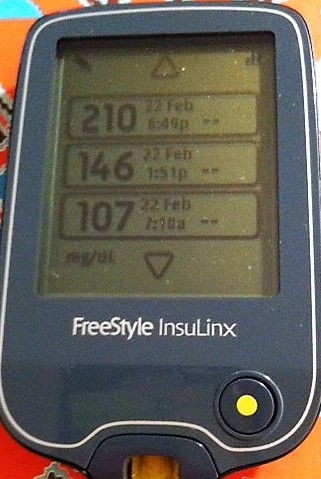
24 minutes to destino. Quick update, I’m on the plane. BG (blood glucose) is 320 mg/dl. Was so low in Raleigh that I couldn’t think. Didn’t take insulin for a long time. We are set to arrive @ 9:44 and then depart at 10:20. As long as no gate change I’ll be at F25 (only 20 gates away from where we arriving). I’m going to write an update at 10:40 pm saying I made it, and my BG will be perfect. Then I will fall into a nice sleep until 4 am, then write for an hour. Someday I’ll learn Portuguese.

This was my last journal entry for four days.

Back on the plane, as we declined in elevation towards our destination, I looked at the screen, then back at the overhead compartment, then at my purse, then at all the people around me, in a nervous loop. There were so many people in front of me, and I knew I had to get off of that plane. A flight attendant walked by. I asked her if she could help me. I said, “Hello there…I know this might be a weird request, but my connecting flight leaves at 10:20, and that lady up there, hers leaves pretty soon too, and if there’s any way we can get off this plane, like, first, or sooner, that’d be great.”

She agreed to make an announcement over the loudspeaker. She was very kind.

5 minutes later, as people rustled around and the captain updated us of our status repeatedly, a quiet announcement urging passengers to allow those with close connecting flights to depart first, was made. The attendant warned me that most likely, people would take little heed, especially those in first class.

And yet a door opened. Behind me, a couple on their way to an island off the coast of Florida, anticipating their vacation, had heard my anxious request. “You’ve got a close connector too?” One of the women asked. I sighed. “Yeah, it’s pretty close…” “Yeah ours got crunched with the delay. What’s yours?” she asked. I told her. “OH, that is close. That makes me feel pretty good about ours.” Despite this, she was very sympathetic. ”Here’s what you need to do,” she said. Follow us off of here and we’ll get you pointed towards the Sky Train. You’ve got to get on the Sky Train because where we are, you’re never gonna make it on foot all the way to your next gate. This airport is a giant.”

Now remember, our flight was arriving considerably early. It was 9:40, and we were descending towards a gentle landing. At 9:44 we touched down.

At 9:55 we were still waiting behind several other planes on a slow, slow pathway towards deboarding. Our huge machine idled in the queue. I began to feel flushed and frantic (noticing a theme?).

My friends from a few seats back knew that everything wasn’t going to go as smoothly as they’d originally presented. They amended the plan. “Ok, here’s what you’ve gotta do. As soon as we get up there, and they turn off the seatbelt sign, we’re gonna stand up and make an opening for you so you can get your backpack and get off of here. And then, don’t look back. Don’t wait for us, we’ll just slow you down. You gotta get off this plane and run like hell. You gotta get to gate 11 (9 gates away) and get on the Sky Train. I think you’ll have to go up some stairs…”

At that moment we docked.

The seatbelt sign went off.

My friends stood up, and I began to act.

I heaved my Osprey backpack from the overhead compartment and hiccupped down the aisle, meeting the line as it slowly moved off of the plane. I stepped onto the connecting bridge and could see the light of the airport at the other end, but I was still blocked by a throng of passengers. I tried to wait patiently because I don’t like pushing through crowds or running around other people who I could potentially crash into. So I slowly trudged along, until suddenly, in the Miami airport, at what was now 10:08 pm, I saw an opening, and I made a break for it.

My backpack was flapping on my back because I hadn’t buckled the waist strap and my purse was bouncing repeatedly into my stomach. If I had ever pushed myself this hard in high school track, I might have placed in a race. I had never run like this before. I also had never run before wearing a 35 lb. backpack. There was no one in the airport, no one out in front of me. Which is sort of a figure of speech because there were a few others, walking on the moving sidewalks which had been disabled because of how late it was. After about two minutes of running, my hair flying into my face, cheeks red, eyes wide, heaving breaths from the exertion, I see a business man and I think, he must know how this airport works. As I pass him on my right, I turn my head like a frenzied bull and with panic in my eyes I scream, “Where’s the Sky Train?!” “What?” he queries back. “THE SKY TRAIN?!!!”

I still don’t know where the Sky Train was. He failed my question a second time and I waved my hand at him in dismissal before continuing to sprint through the deserted airport.

Up ahead, one of those little cars was sitting horizontal in my path. As I approached it, I yelled to the conductor, “Please, sir, I’ve got to get to gate F25,” and instead of dodging it, I jumped on (not recommended behavior).

I learned my friend’s name, and where he was from, and that he had no faith that I would make my flight because moments before he had taken the last passenger who they were calling for over the loudspeaker to the very same gate.

I disagreed with him, but I was grateful for his kind presence and effort, nevertheless. We sped (at 5 mph) through the airport. My hair flew behind me, finally out of my mouth and eyes. I began to try to breathe again, although my lungs burned and my chest was tight. I was invigorated, I was going to make it. I had 1 minute before they would close the gate at 10:10 pm as we neared F25.

…To be continued.