Camping with the Omnipod 5

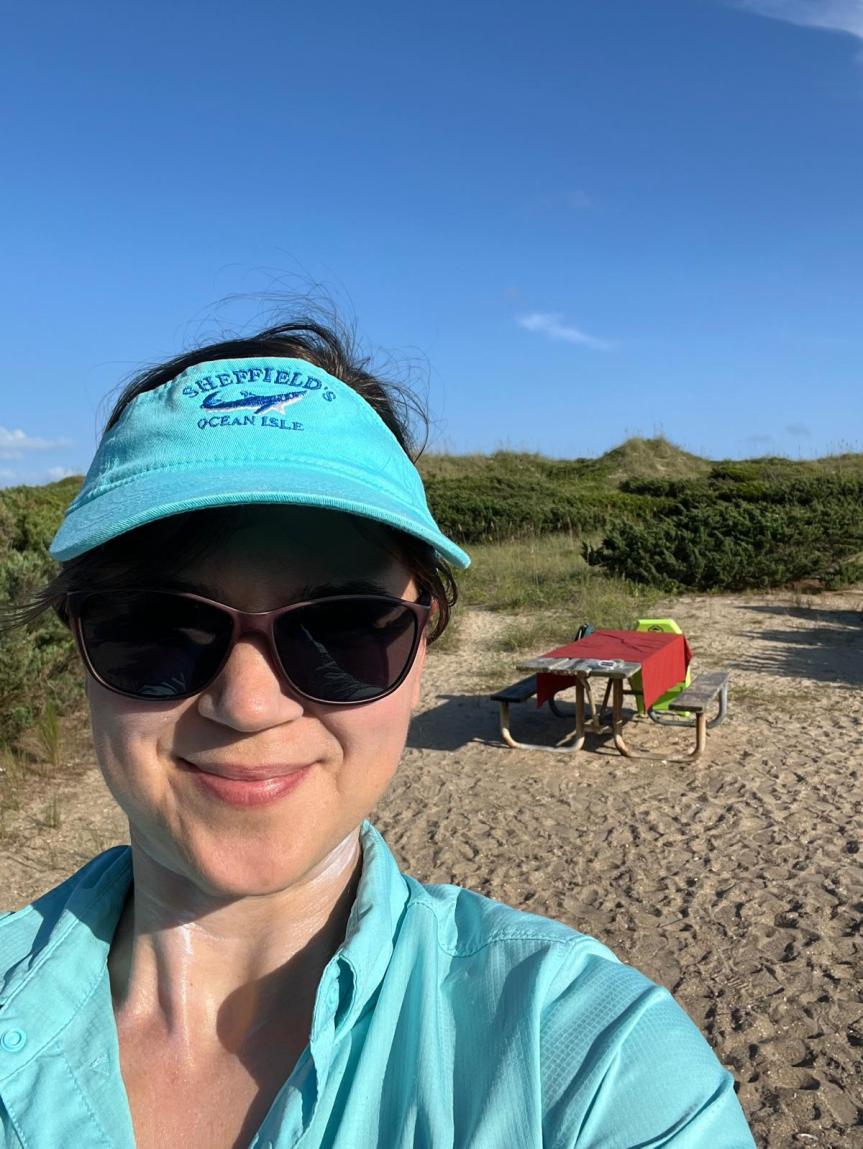
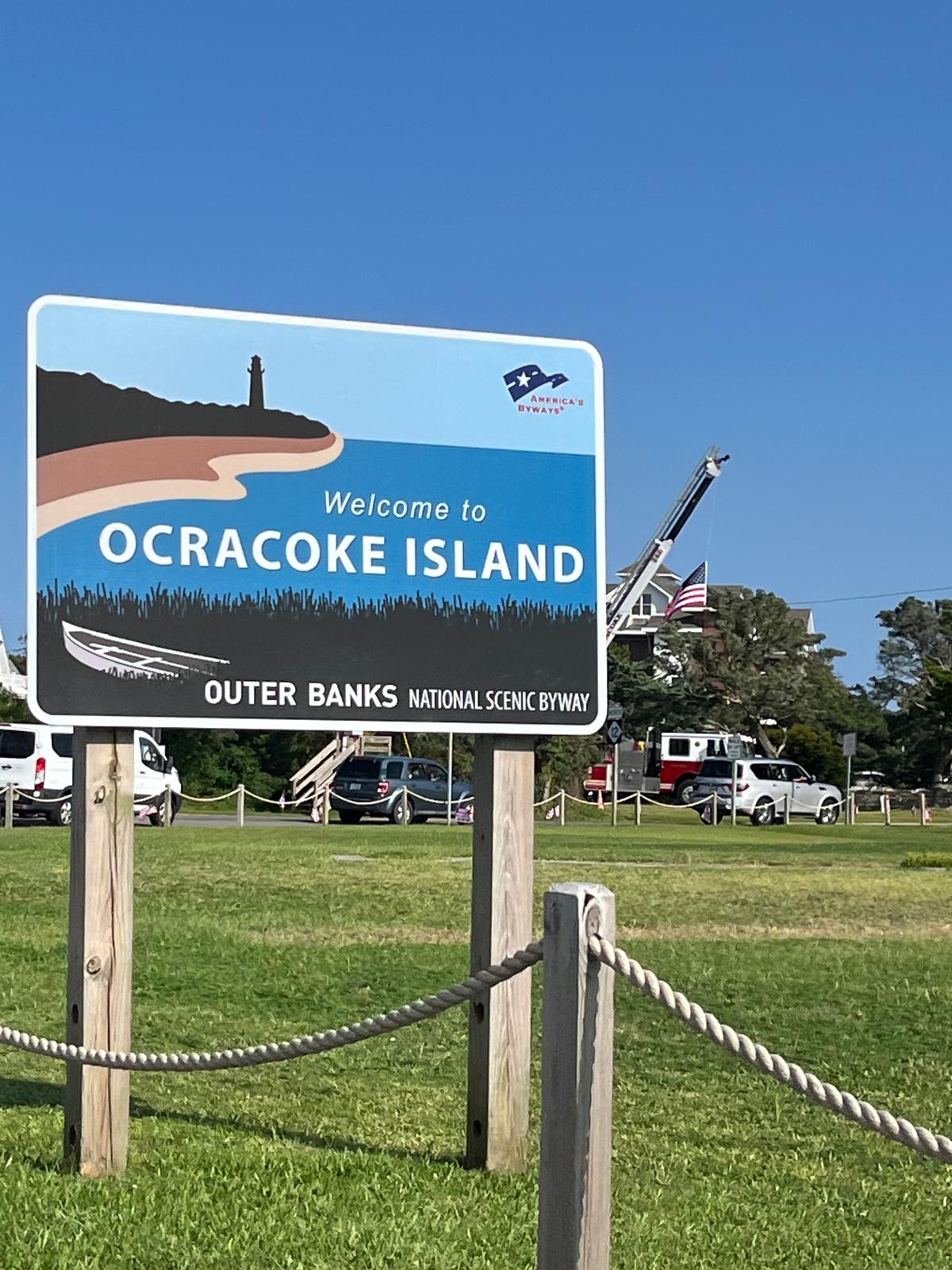
Grad school really interfered with my camping habit. In the two years before I started the program, I was on a camping spree, spending more than 25 nights outside. Now that I type this out, I realize that’s really not many – roughly 3.5% of the time. Maybe some year in the future I would like to spend 25% or more of the nights outside. But in any case, during the two years I was in my graduate program, that number dropped to 0. Luckily, this past weekend broke the dry spell and offered a night on Ocracoke Island, in the middle of parallel stands of juniper bushes, one dune away from the waves of the Atlantic Ocean. It was my first time camping with the Omnipod 5 system, and like nearly everything with the Omnipod system has been for me, it felt easier. Learning from the trip I wrote about in my previous post, I packed an anti-nausea medication prescribed by my doctor and familiarized myself with the location of the island medical center. I also brought an external power brick to make sure I could keep my phone, which I use as my CGM reader, and my Omnipod personal diabetes manager (PDM) charged. The only thing I remained concerned about was the chance that my medication would get too hot in the late August sun, or that my pod or CGM would work its way off in the salty water.
The first concern was easy to mitigate. We were only camping for one night, so we brought a cooler full of plenty of ice, in which I placed my small medication coolers. I have used these coolers ever since my trip to London a year and a half ago, and I have found them wonderful for keeping my medication cool on their own, or when stored in a larger cooler for longer trips. I find the cooler in a cooler technique extends the overall cooling power of the small coolers, while also insulating the insulin from freezing, as I would worry about if it was directly up against the ice. While it is recommended that insulin be stored in the refrigerator to maintain its effectiveness over time, freezing ruins insulin. For this reason, I do like to keep a small amount of insulin in a separate cooler that is not up against ice at all, just to be cautious and ensure that I will never be in a situation in which all of the insulin I have with me freezes. On this short overnight trip, we did not even have to buy more ice, and my medication stayed sufficiently cool.
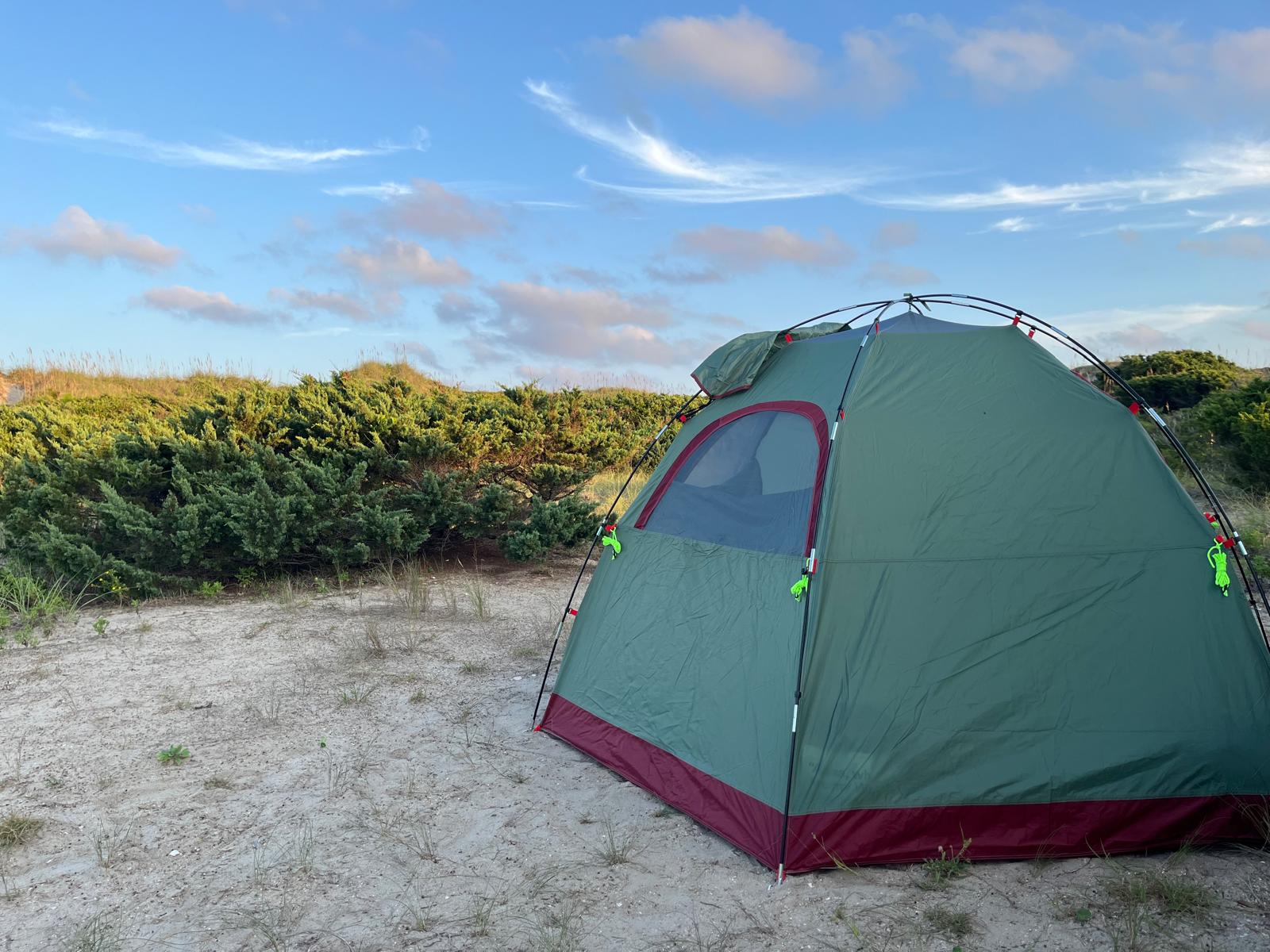
We pulled into the Ocracoke Campground, part of the Cape Hatteras National Seashore, after a nearly three hour ferry ride. Because it is a national campground, I am able to get a lifetime discount using my Access Pass that having Type 1 diabetes (T1D) makes me eligible for, and which can be obtained from the National Park System. (Now, we need guaranteed affordable access to life-sustaining insulin and supplies!) The land of the campground is sandy and windswept, with low vegetation and dark supple leaves that may be marsh-pennywort interspersed in the grass. When we arrived at our campsite, we immediately set to putting the space in order. Car camping brings a different level of luxury and offers the potential to really add style to your overnight home. On this trip, I brought my trusty big red tablecloth as both a cover for the picnic table and a beach-sitting surface area to protect against sand fleas. For the evening, it created an inviting setting for our dinner of cauliflower steaks, corn, and a pre-prepared curry tofu stir-fry, which we cooked/heated over charcoal. Easy dinner allowed us to maximize evening beach time. Beach camping is not very comfortable,* and the only place that seems to be reliably free of biting insects is right at the edge of the waves. When we crested the sand dunes, the light had softened, but the sun still illuminated the clear water so that we could see through each turquoise wave as they crashed into the sand. We both agreed that the water here was bluer and clearer than the rest of the Outer Banks, perhaps because of less dense shoreside development.

*But it’s worth it for the stars! Also, wearing long sleeves, long pants, and a bug net around the site really helped reduce bug bites.

I don’t think I am inherently a very organized person. I base this off others in my life for whom order seems to come naturally. What comes more naturally to me is packing in a haphazard way based on what activity or need I think of at any given time. But organization does seem to lead to organization, and establishing a camping box where I keep all of my supplies, organized somewhat by function, has really made the thought of camping on a whim less daunting and the whole process easier. Checking and repacking my diabetes supplies is necessary every time, so if I can establish ways to keep other aspects of my life and my activities organized, it frees up more time and space for me to use on diabetes, without setting me up to resent that I have to.
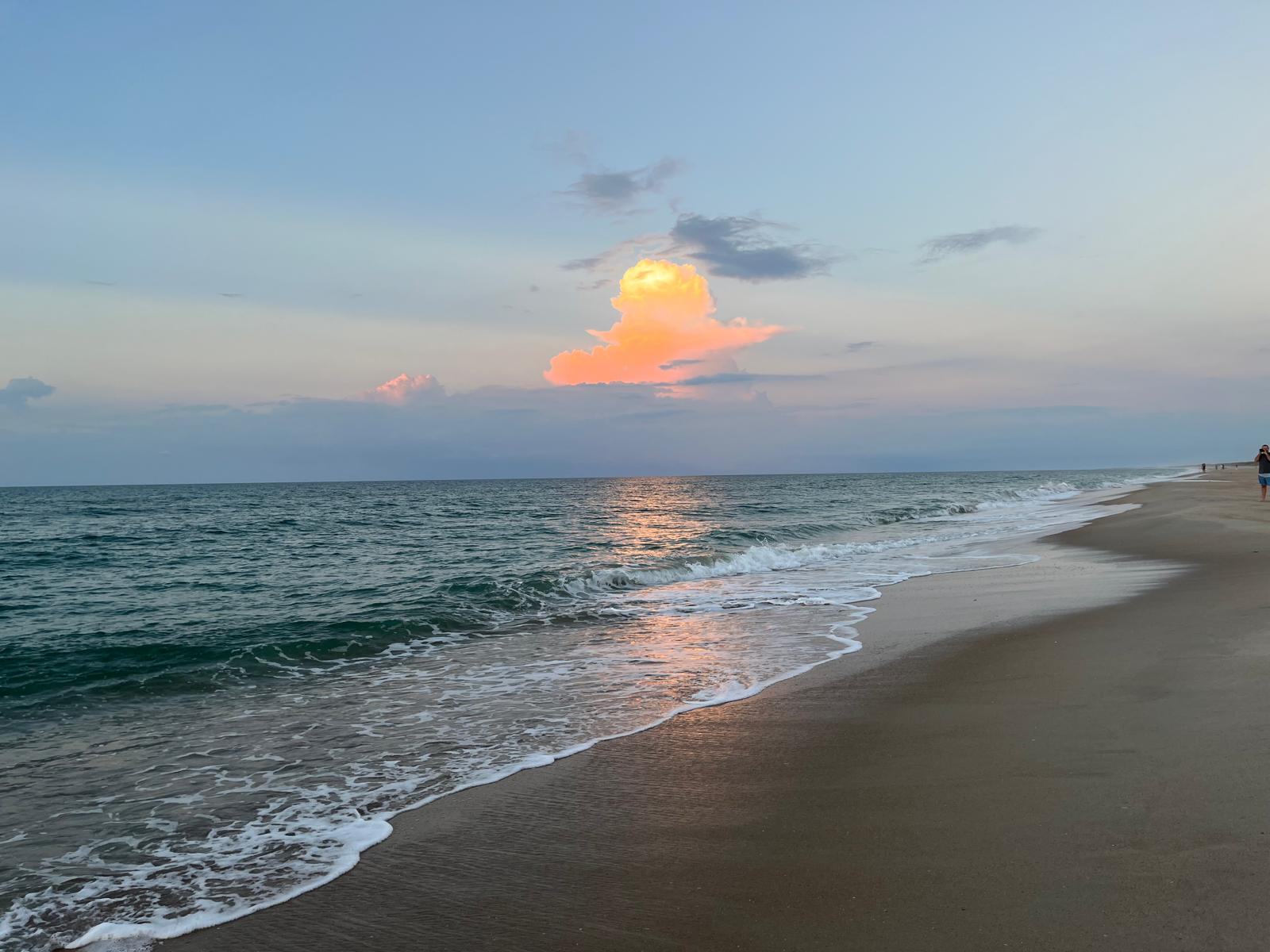
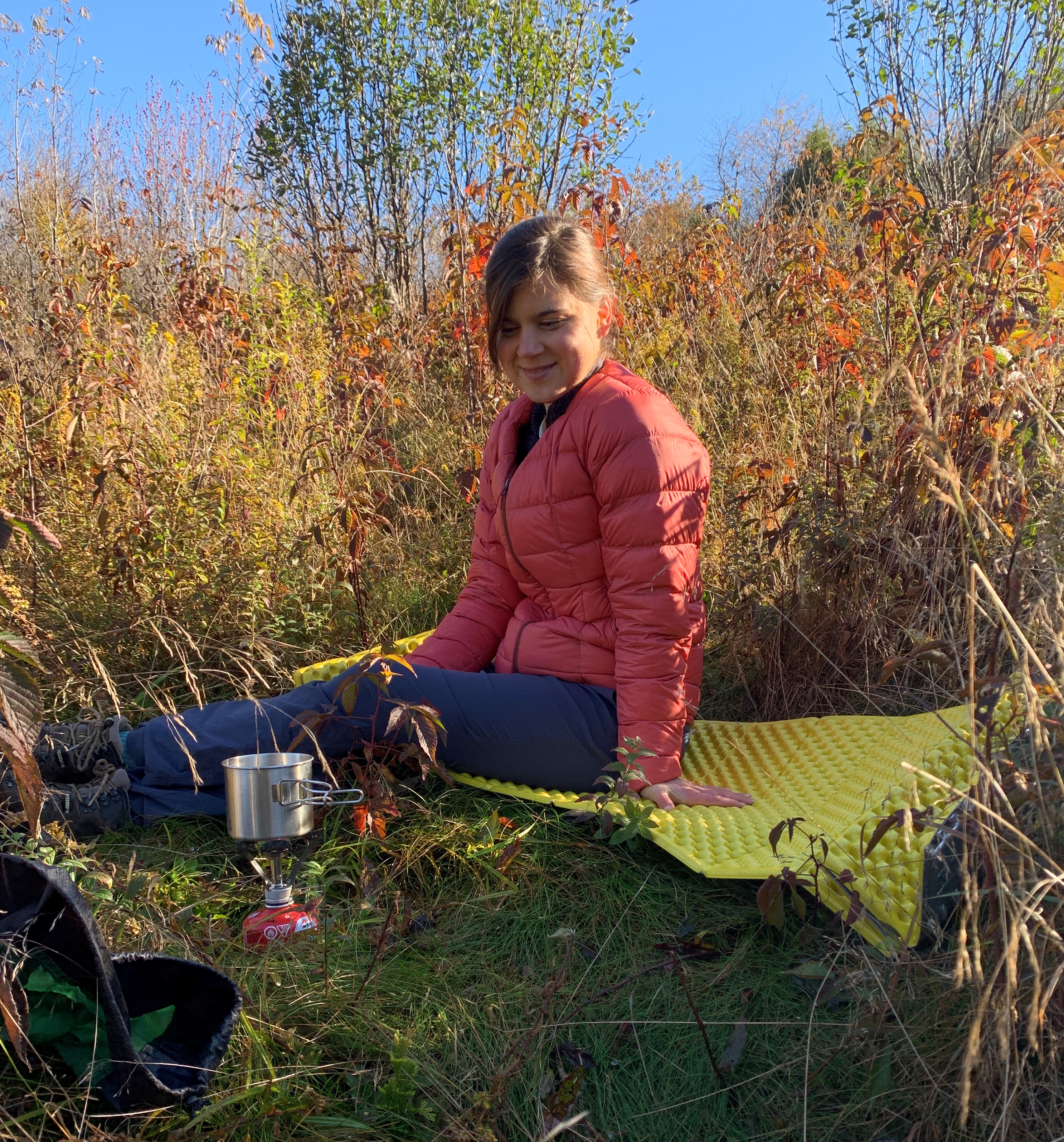
One of the most important pieces of camping gear on any trip – my favorite piece of gear in fact – is my MSR pocket rocket camp stove. I love to take it out of its little red case and spin it onto a fuel canister. I love flipping out its three wings and listening for the whisper of escaping fuel as I twist the handle before lighting it. It’s so satisfying to cook on that little stove, and it has allowed me to have a cup of instant coffee in some of the most beautiful places, one of life’s true delights. I am not usually excited about waking before sunrise, but knowing that we could stumble over the dunes to the soft greys of the morning cloaking the sand and waves, and brew a cup of strong instant coffee while waiting for the first rays to crest over the low cloudbank, made me excited to throw on my bug net and jump out of the tent. And because we were so close, bringing what I needed for diabetes was as easy as throwing my Omnipod pdm and phone in my fanny pack, along with the stores of fruit gummies, honey packets, and Werther’s I keep stocked in case of low blood sugar. 

After the sun illuminated the waves once again, we splashed around for few hours before packing up our site. The sweat, salty water, and crashing of the waves eventually did begin to work my pod off of my body. I had brought along some ‘overpatches,’ which is a tape cut into the shape of Dexcom sensors that I sometimes also cut to cover the edges of my pod, but realized I should have used it before the adhesive of my pod and CGM got dirty and began to peel. My pod ended up straggling along to the next day, its adhesive curling and needing to be pressed down several times. Next time I do any beach frolicking, I will plan to apply extra strips or patches ahead of time.

Before we left our campsite, we paused to breathe and take in the chiming chirp of the grasshoppers and shore insects, the briny smell of the place, and the occasional gritty wind that whisked around our ankles. We did a sweep to ensure we collected any remaining trash, feeling lucky to call that place home for a night. Before we rolled onto the ferry for our return ride home, we stopped at a bustling café in the village for a hearty meal. Even with low treats and camping snacks, I was in need of a solid meal to stabilize my blood sugar after the added running around that comes with accomplishing daily tasks from a campsite. From walking through the scrubby fields to the outdoor showers, to breaking down and packing up our tent and supplies, everything takes a little bit more energy than it might at home. And while my blood sugar was high on the ferry ride back, it coasted down to a comfortable level before I fell into bed that night, still feeling my body rocking back and forth from the sway of the ferry on a choppy sea.

*As always, all views expressed are my own. I share my personal reflections on T1D and my writing is not medical advice.*

Components of Healing and Wellness

Before my diagnosis back in 2005, I had been sick for months. I knew nothing about diabetes (oh how much has changed!). In those months, I’d told myself that even though I could barely get out of bed, was losing weight rapidly, and once passed out in the library for hours, I was probably fine. Turns out, I was not. By the time I was diagnosed with type 1 diabetes (T1D), I was in diabetic ketoacidosis, which means that my body had started to burn muscle and my blood had become overly acidic due to a buildup of ketones. As a person with T1D, I am at risk of this life-threatening condition throughout the course of my life if I experience any interruption to my insulin, including if being sick means that I cannot take insulin as usual.

I preface with this because I want you to know that seeking help is not something that comes naturally to me – at least not until things get really bad. Which is why I was surprised when, overcome with intense dizziness and nausea, I found myself on all fours in the back of a plane yelling “Help!”

It was about a year ago when my friend (who is also my colleague), and I were on a flight back from Germany where we had participated in a conference talking about the need for equity when it comes to closed-loop insulin delivery technology. If that’s confusing, I’ll explain, so stick with me. We were approaching the last leg of our journey, headed back to London to spend one night in the airport hotel before I flew back to the States, and she returned to her town.

It could have been dinner the night before, it could have been our midday snack, it could have been travel stress or any number of things – the point is, I got violently ill on the plane. I will not go into details of that except to say, when I cannot keep food down, I run a greater risk of becoming dangerously dehydrated and going into DKA. If I cannot eat/absorb food, taking insulin becomes dangerous because of the risk of low blood sugar, but if I don’t get enough insulin, my risk of DKA is greatly increased. It can be a dangerous loop. That is why, at around 11 pm, when my friend and I had finally checked into our airport hotel, she suggested we consider a trip to the ER. This brings me to what I have identified as the three key components to my personal sick day wellness strategy with T1D.

1. Having a detailed plan

When I was first diagnosed and in the few years after, I prepared extensively for travel. As I became more comfortable with diabetes management over the years, I let some of my preparation slide. While experiencing less anxiety over what could go wrong has been really great, preparing for what could go wrong is still essential for me, which I was reminded of on this trip. I was also reminded that the time to prepare is when I am well. Luckily, I had support, but if I had been traveling solo, as I have in the past, I could have ended up in really bad shape.

2. Willingness to accept help

I admit that I was resistant to the idea of going to the ER. For the first18 years of my life I did not have T1D and I dealt with sickness differently. But my friend has weathered more sick days with T1D than I, and I really trust her. Once she finally convinced me, she called an Uber and set the wheels in motion. When we climbed in, she told the driver where we needed to go, she let the front desk know that we were checking out and would not return. I simply languished beside her as she orchestrated my safe passage to the ER. It was also she who sat next to me in the ER for 6 – 8 hours and reminded me to check my ketones, check my blood sugar, and generally kept an eye on me.

3. Available help from someone understands diabetes and can be your advocate

The other thing about having help from this friend was that she really gets diabetes. She knew what to say to the staff at the ER to get them to take my concerns seriously. She knew that my rising ketone levels were a problem. She minimized nothing and was an advocate for me when I could not be. I have thought about what I might do if I was alone in this situation and identified a few things I learned from her that I will carry forward, specifically knowing where the nearest ER is anywhere I go, and having an up-to-date sick day note that specifies what I need if I am sick. Even though I might know no longer need to reference these as written guidelines, it’s helpful to have them at the ready for medical providers or others I might be traveling with. Before I go on my next trip, I will do preparatory work ahead of time, when I’m well, in order to be that stable friend for myself if I need to be. *This post’s featured image is one of us a few hours before I became ill.

4. Supportive technology or access to supplies

This one I want to spend a little bit more time on. For the past year, I have used the Omnipod 5 system in conjunction with the Dexcom 6 CGM. This means my insulin pump, which delivers my insulin, can communicate with my continuous glucose monitor (CGM), which measures my blood sugar. This allows my insulin pump to automatically adjust my basal insulin, which is the continuous background insulin that I need, to help me stay closer to my target blood sugar range. There are still a lot of inputs required from me such as carb counting and bolusing for what I eat, adjusting based on my physical activity, and the logistics of site changes and troubleshooting. The pods, which I change every three days, are expensive, even with insurance, costing $140 a month. However, while in grad school, the amount of time and energy the system has saved me has felt invaluable, even though it has meant taking out loans to pay for school. Previously, I was making up for the work the system is now doing, and when I went on this system I became aware of a renewed energy and increased capacity to focus on my schoolwork and be engaged with part of my mind that had previously been allocated solely to diabetes.

When I became sick abroad, my perception of the system as something that I had to justify to myself shifted to something that was a life-saving necessity. All the while that I was unable to eat and finding it hard to even think about diabetes, my CGM was reading my blood sugar and my insulin pump was giving me little micro-boluses to compete with its rising levels as I slowly drank soda and other fluids. By the end of the 24-48 hour period, it had given me an amount of insulin within my usual daily range, and kept me hovering from 150 – 180 mg/dl, which for me was a good sick day range. That is work I could have been doing, giving myself shots with a half-unit pen, but not nearly as precisely and definitely not as effortlessly. In fact, that would have added a new level of error that would have most assuredly brought more difficulties my way, which I say from previous sick day experiences.

It was amazing to be able to just focus on healing, instead of micro-managing blood sugar all day. In fact, once I made it through the nausea, I remember my recovery day as peaceful, rather than miserable, in part because I was not working, not in school, and not really focused on diabetes. Just resting and being cared for.

For years, in fact from the first weekend of my diagnosis, the narrative I have heard from many healthcare providers and diabetes organizations has been “if you take care of yourself, you can live a completely normal life with diabetes.” I get that this can empowering for many people, but I wondered for many years why I felt like I was failing to achieve that normalcy. Yes, I was managing to pursue my dreams, but I was working so hard, filled with anxiety, and felt like I was struggling to keep up. It might have looked normal from the outside, but from the inside, it felt like a continual marathon. Since I began using this system my life has felt a lot closer to normal – and I can barely afford it. I think my more accurate narrative for many years was, “if you work constantly, other people will think that you live a normal life, but you will know that you can keep fooling them only as long as you are willing to keep working 24/7 and say that you’re fine.” Or maybe, “you can live a normal life, but only if you have really amazing health coverage and a good deal of expendable income and supportive family and friends and adequate time off from your job…”

Now, at this point, my narrative has shifted to encompass the emotional adaptation to T1D that has been part of the journey for me. After many years of T1D I think my most accurate narrative is, “your new normal will be planning and adapting to the unexpected. It will be asking for and accepting help and meeting really amazing people who are navigating T1D too. It will be learning to rest and do less every day so that you are able to enjoy what you do. And it will be feeling like you are failing sometimes and living in fear of your health insurance coverage changing or ending.”

It makes me think that maybe if we said all of that, rather than saying, “you can live a normal life if you take care of yourself,” we would be forced to confront the need for support and the reality that without adequate, reliable, affordable access to diabetes management supplies, normalcy is a false promise. Moreover, we would take the relieve some of the burden from the person with diabetes and center it appropriately on healthcare systems, which are currently leaving many people out and bankrupting others.

I’m concerned that when I’m no longer in grad school, I will not have an insurance plan that allows me to get supplies at even the cost I currently pay, and I will have to go back to shots. It’s amazing the reservoir of mental and physical energy that going on such a system opened up for me, and I want that for anyone with T1D who is interested in such technology. That requires prioritizing insulin access as a human right. For many people in the world, shots or even vials of insulin are not guaranteed, and this is a horrific injustice. Battling supply scarcity and paying a huge chunk of your income just to have what you need to live steals the energy needed to dream and thrive. So as this amazing technology progresses, my hope is that for each advancement in diabetes tech, there is the same energy and eye to access for all people with T1D, both for the technology itself, and the insulin it requires.

*As always, I share my personal reflections on T1D and my writing is not medical advice.*

Blood glucose and the stress response

My travels to Ohio last weekend were more exciting, but very related to, this post’s title. I have been less interested in travel over the past year, as the COVID overlay has made everything just a little bit more tiring, both in the lead up and the recovery. Wearing a mask all day in the airport, making sure I understand the ever-changing travel requirements, and just being worried in general about the virus has discouraged me. But this past weekend I was happy to be getting out of NC and headed to Columbus for a dear friend’s wedding.

I arrived at the airport a little less than 2 hrs early and made it through security in less than 15 minutes. I settled into the gate to wait for my departure, when it became clear that the flight would be slightly delayed. My connection would be tight, but I’ve made tighter, so it didn’t seem problematic. But then the flight was delayed further. Now we would be arriving at my connecting departure time. Obviously, this would not do.

Before learning that there was no way I would make my connection, I had been entertaining myself by scrolling through my mind to see if I could find something to worry about. I get this way on travel days. I think it comes from the necessary process of asking myself, “do I have everything I need to survive over the next X days?” I usually stick a post-it note inside my front door: “insulin; a way to get insulin into my body; test strips, poker (lancet device), and backup meter; charging cord; contacts; glasses.” If I’ve got this stuff, I’m gonna survive, so I’m good to go. Still, the packing and double-checking leaves me with this feeling of, I’ve surely forgotten something important and, subsequently, a vague sense of unease. But, what I love about travel is that it’s unpredictability almost always jolts me into the present.

This was true when I learned that I would not be making my connecting flight, and even truer when the agent on the phone said, “We’re going to do everything we can to help you,” followed by, “I’m sorry, but there’s really nothing we can do,” in the same conversation. There were no seats on later flights that day from Charlotte to Columbus. “Could I fly into Dayton, OH and rent a car?” the airline agent asked. “Only if the airline will pay for it,” I countered. “Oh, I’m not in charge of that, you can write to customer service.”

We all know that when a company that has its own app and operates giant flying machines wishes for you to write somewhere, this means they intend on doing everything they can to not give you any money.

So I declined Dayton and also declined the option of leaving Charlotte at 10:30 pm Friday and arriving in Columbus at 10:30 AM Saturday (“What? how could this even be possible?..” you ask. The layover would have been in Phoenix, AZ. Don’t fly to Phoenix from NC to get to Ohio. Just don’t do it.)

The point of this story isn’t the weird details of how I got to Ohio, although I did make it. Ultimately, I decided to take the risk of getting on the flight (inspired by my previous success) and making it standby for a later afternoon same-day flight. The point of the story though, is what happened to my blood sugar during this whole ordeal.

Graph Alert!

Graph 1 shows my blood sugar during the hours before and after finding out about the flight delay. Notice how I spike around 11:45 and stay above 200 for much of the afternoon.

Graph 1
Graph 1

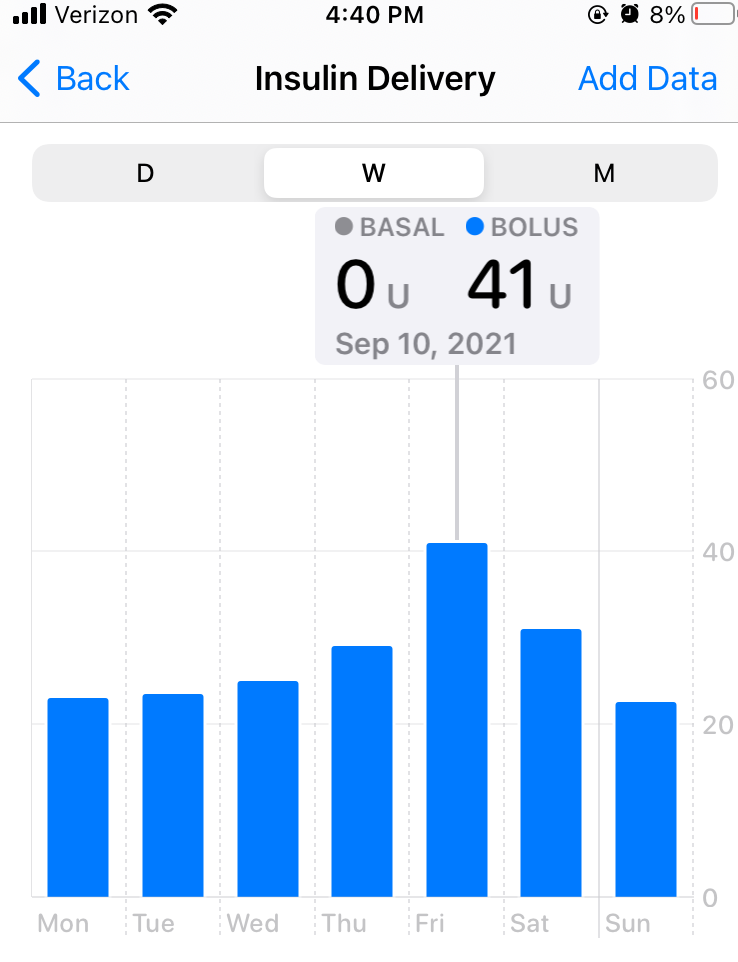
Graph 2 shows that I had to take 41 units of insulin that day to keep my blood sugar in range. The other bars show a useful comparison of ‘typical’ days.

Graph 2
Graph 2

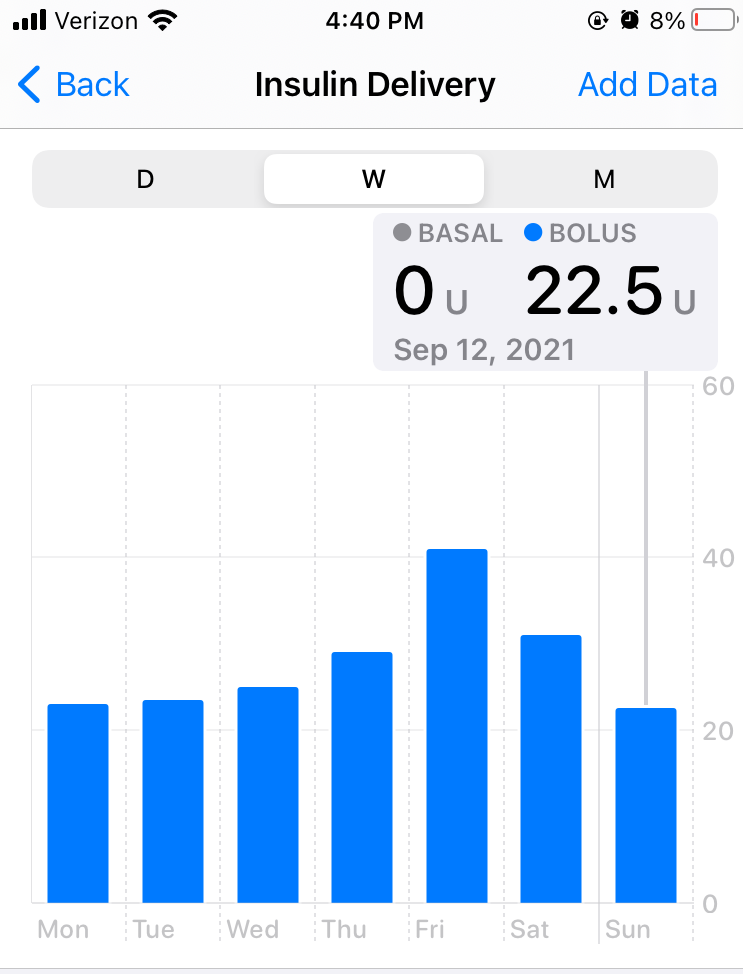
Now, don’t let me fool you, there are no truly ‘typical’ days with diabetes, but to give you a reference, my average short-acting insulin use per day has been about 25 units a day over the past few weeks. So, even allowing for the necessary amt. of typical variability, 41 units is an extreme anomaly. Graph 3 shows how many units I used on my return day, which went off without a hitch. Graph 4 shows my blood sugar on a more stable Friday, one week later.

Graph 3
Graph 3
Graph 4

What is it about stress that tends to make blood glucose spike and also makes us more resistant to insulin? Well, it comes down to a few things interacting together.

First, let’s disentangle the state of being stressed from various potential stressors. It’s the process of becoming and being stressed that raises blood sugar – aka the response. I like the definition of stress provided in here, “Essentially, stress can be considered as anything that tends to change the control that you have over our body and our emotions.”1 While I don’t much like this article’s terminology or conclusion, I do like this definition because there is a synthesis that has to happen between a stimulus and the stress response in our body. Some people are stressed by holidays – it’s not that holidays are inherently stressful – it’s our associations with them. When I heard that I would not make my connector, the associations I made were:

  • I’m going to miss the wedding
  • I’m going to let all my friends down
  • I’m going to lose the money I paid for this ticket

All of these thoughts were very paralyzing. I was also low at the time that I was trying to rebook my ticket and literally couldn’t figure out the order I needed to do things in. Interestingly, it was diabetes that got me back on track. Once I recognized that I was low, I stopped frantically flipping between my American Airlines app and my web browser, and hung up the call line I was waiting in. I ate some Annie’s gummy bunnies (sponsor me, Annie’s?) and took some deep breaths. I then realized that I would survive and everything would be fine.

But my blood glucose had already received the signal that it was go time. And in truth, it was. I had to make calls, decisions, perhaps hustle from one gate to the other, so it was great that my body was ready for that. When we get stressed, either physiologically or mentally/emotionally, the body releases certain chemical signals and hormones, namely epinephrine and norepinephrine, to prepare itself to take action.1,2

Brief aside – I hate the term ‘fight or flight.’ It’s overly binary and it leaves out freeze. Personally, I first exercised freeze, as previously described, and then I chose to fight respectfully on the phone with the first American Airlines rep who I talked to, before moving to schmooze, which is really another key omission in the term. After schmooze, I finally landed on plead, which was really the ticket.

Anyway back to stress hormones. So when the body releases these ‘stress’ hormones, they stimulate the liver to actually produce glucose (what, the liver can make glucose? Read about that here and see some cool diagrams).3 The liver releases that glucose into our blood stream, thus raising blood glucose levels.

So at this point, maybe you’re making some conclusions. Perhaps you’ve decided that stress is bad for blood sugar. This used to be my perspective too. Now, however, I would say that it depends. In truth, my body is doing what it’s supposed to do – preparing me to handle a situation. Wow, thank you, body. An important conclusion though, is that your response to stress really matters on a physiological level (I’m looking at you too, people without diabetes). There are a couple of ways I’ve learned to manage the effects of stress that I typically deploy with varying success. During my travel day, I tried to keep some perspective on the issue at hand. I had a support network to help me out if I was stranded, I had a cellphone to call customer service, and above all, I’ve been through things like this before and been just fine. So I reminded myself of that, did some deep breathing, and remembered quicker than I could have that I could handle the situation. The second thing, and this is the most important in my mind related to blood sugar, is that I no longer get as stressed about being stressed as I used to. Earlier on in my diabetes days, I would be watching my blood sugar climb over the course of the day and get so distressed about higher than normal levels. This would then perpetuate the stress cycle and I’d be left with higher than usual blood glucose levels for days. I think that over the course of my time with diabetes, I’ve lessened my expectations for consistency in how I feel day to day, moment to moment. I’ve also tried to let go of that idea of perfect, normal blood sugar, and employ more gratitude for my body’s efforts to get back to stability. I don’t always succeed, but it’s been a relief to try.

The sources linked here will provide you with more information, but remember that no source is perfect or absolutely complete and that no one person’s experience of diabetes is representative of the whole.

People with and people without diabetes, please let me know in the comments how your blood sugar/body reacts to stress and some of the ways you deal with it!

Sources:

  1. https://www.diabetes.co.uk/stress-and-blood-glucose-levels.html
  2. https://pubmed.ncbi.nlm.nih.gov/1425110/
  3. https://dtc.ucsf.edu/types-of-diabetes/type1/understanding-type-1-diabetes/how-the-body-processes-sugar/the-liver-blood-sugar/
“And the pitch, it’s a delayed flight! She knocks that stressor out of the park!”

Planning for fear

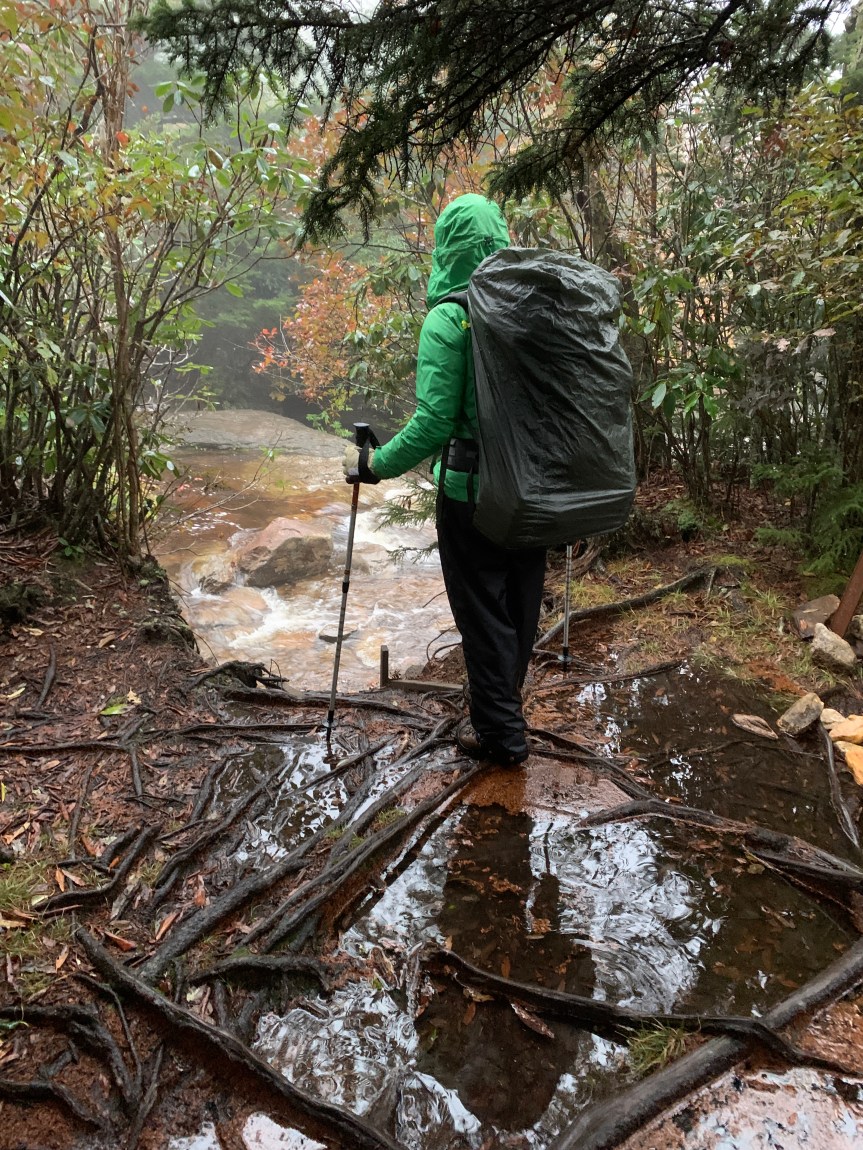
Last week I entered a time capsule. It was dark, damp, and cold as we prepared dinner after hiking into a fog so dense that I was shocked when we came to the fork at the base of Sam’s Knob, left to the creek and right to the summit. We had crossed the entire field in front of the mountain without once seeing its mighty figure in front of us. We headed left towards the creekside campsites that I remembered from many years and times before. In fact, I camped beside Flat Laurel Creek during my first ever backpacking trip. That trip, maybe ten years earlier, had started much the same way – with a rainstorm forcing us to pile on every layer we had brought within the first few hours. This time, turning off the parkway and into the parking area for Sam’s Knob, we were the only car save for one. The two guys in the other car were milling about while we worked with raincoats and pack covers to protect ourselves from the intermittent rain showers that threatened to soak us and our gear before we began. They, young, clean, and looking a little lost, wandered over and asked, “Hey, would this be a good time for a hike?” It was chilly and windy, nearly 6 pm, raining lightly, and there was surely standing water in the trails. “Absolutely not,” I said. “This would be a miserable time for a hike,” as my hiking buddy continued to layer and arrange our supplies. “You should come back tomorrow,” I concluded, as we hoisted our packs. “It will be beautiful then.”

That’s what we were banking on anyway. We’d delayed the trip by one day, hard for me once I have my mind set on the woods, but it promised to be a better plan. While it had been raining for the previous day and night, sun and clear skies was forecasted. All we had to do was stay mildly warm and somewhat dry until morning.

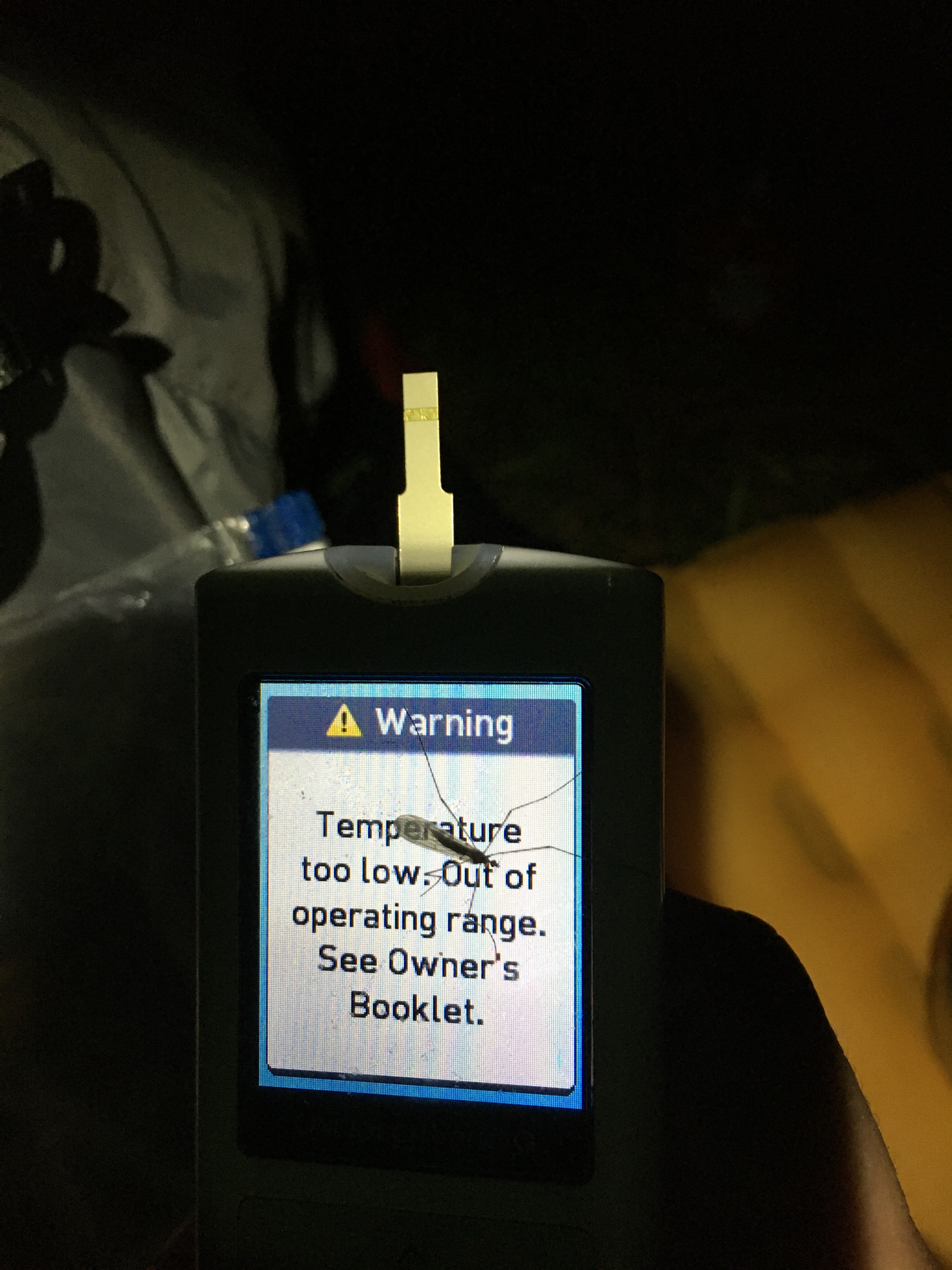
I started this blog years ago, inspired by the lessons I learned about diabetes management and myself while backpacking. It diverged, first into kayaking and other outdoor adventures with diabetes, then into topics like acceptance and identity transformation. As I’ve gained experience and had successes problem-solving around unexpected moments with diabetes, like a malfunctioning pod moments before boarding a plane, insulin that overheated in another country, low blood sugars alone, and other occurrences that throw the brakes on every other priority you thought you had, these same moments become less noteworthy. It’s been more likely in recent years for diabetes to surprise me in a philosophical way. So, when I stuck a test strip into my meter to check my blood sugar while simultaneously tending the pan of lentils and rice heating on my little MSR camp stove, I didn’t just see the message, “WARNING – Temperature too cold. Out of operating range. See Owner’s Booklet,” I also saw my younger self; imagined her sitting by the creek ten years ago, overwhelmed by a shock of fear.

There she was, running through a script in her head of everything that could go wrong, of everything that she had to pack in order to survive in the woods. Should the list be so long for one night? Should the consequences be so grave? And then, to be foiled by something you could have never predicted so early in the diabetes game – a meter too cold to function. I felt like hugging her now, as I sat calmly contemplating the crane fly who had been drawn to the screen’s bright glow.

It occurred to me in that moment that sometimes you have to go back to the diabetes basics. It’s not all about the esoteric details of acceptance. Sometimes it’s about snuggling your meter in your sleeping bag as if it were hypothermic until works again. Of course, I gently removed the bug first. This time, I felt confident that my meter would resume functionality because I’d been through similar, though not exact, situations before. I also knew that I had packed an extra meter that was buried deep within the pack, likely in a warmer spot. I had reached for my meter preventively, not waiting until so much time had passed that I had no sense of what my blood sugar was. In short, I was prepared enough to be confident instead of afraid while addressing the issue. I don’t say this in an arrogant way. I fully anticipate moments of fear arising in the future – am planning on it. But zooming out on this small experience was a powerful reminder of how much I’ve learned and grown with this condition.

I was recently talking to my backpacking buddy about the process of learning to do things that I had loved before diagnosis, like camping and kayaking, and new things like backpacking, with diabetes. That process was never just about learning the details of management during different activities; it was equally a process of letting the fear subside. I likened it to what I’ve heard some people say parenting the second child is like. With the first child, you’re on guard for everything. Danger abounds. But by the second child, you’ve gotten through emergencies and been ok enough times to realize that you have more wiggle room than you thought. As I was journaling about this trip though, I realized that it’s also about what those experiences teach you in terms of preparation. I remember being so disturbed when I was first diagnosed that I could no longer run off into the woods and survive “on my own.” That I was dependent not just on two types of insulin, but on meters and batteries and test strips and ketone strips and glucagon kits and glucose tabs and carbs and lancets and alcohol swabs and lancet devices and pen needles and frio packs© and backup of all those things – and that’s just diabetes. All these details and what to do with them and when. It wasn’t really that I was learning how to backpack with diabetes, but more like I was learning how to diabetes through backpacking. Of course, not just through backpacking. I’ve learned the most about diabetes by stepping out my comfort zone. Now, the woods have always been a comfortable zone for me, but the only truly comfortable diabetes zone is near the kitchen with all your supplies and an omniscient level of knowledge about what’s going on in your body. So, traveling, camping, or any other significant change to your routine presents the opportunity for a loss of control and subsequently, inevitable fear. My moments of fear with diabetes have taught me the most about how to handle it, what my margin of error is, and what it takes to be prepared in various situations, known and unknown.

When we reached Flat Laurel Creek, we found it had become a swirling, copper-colored river. I was overcome by its transformation; still beautiful, but ominous in its power. Part of why backpacking has felt like more of an escape even than usual during this pandemic time, is that being outside reminds me that our expectations for constancy are not mirrored by the Earth. Because, as I discussed last post I cannot predict the future, being prepared becomes a process of planning for things to look differently than the ideal. With backpacking, this is a fine line, because weight really does matter and discomfort and danger are two very different things. Sometimes, I find that because my mind is so preoccupied with packing everything I need for diabetes, I forget the importance of all the other gear. I over-emphasize diabetes preparedness as if it were isolated from the rest of me, but as previously mentioned, diabetes is just a bonus on top of all the other processes of survival, like staying warm, fed, and hydrated. So, recently, as I considered whether I could cut some of the weight that I add with diabetes supplies by just being dirtier, aka packing less clothes, I thought about dropping my customary backup pair of socks. I mean, if they get wet I can just dry them out, right? After splashing through several puddles in my decade-old hiking boots that were once waterproof, I was thankful that I had not yet enacted that plan. My feet were wet and I knew they would be cold soon if I didn’t act. For me this feels scary. Once my feet get cold, they just won’t warm back up on their own, which usually leads the rest of me to chill. I didn’t want to become like my meter, too cold to operate. The clouds hung heavy overhead and the wind was picking up, making the little stove work extra hard as I fumbled around in my pack to find the smaller bag that contained my clothes. My hiking companion was off searching for firewood as an exercise in optimism that we gave up on shortly after. Unzipping the smaller bag, I sorted through the layers I had brought – booties, long underwear, and then, just as I began to worry that I had left my spare pair in the car, my teal wool socks appeared. I layered my down booties over them and curled my feet under my body as much as possible. After a (finally) hot dinner I was feeling, if not toasty, warm enough.

Right before curling into the tent, after scraping the last bit of dinner from the pan and tidying our food and toothpaste into the bear canister, the clouds broke and the deep night sky emerged into view. The nearly full moon shone a spotlight on my yellow tent pitched in the middle of a small clearing by the little fork of Flat Laurel. I can’t say I slept warmly, but rested peacefully, nevertheless. The next morning was perfectly cloudless – not even the lightest dappling of shadows. Our solitude at Sam’s Knob quietly evaporated and was replaced by the voices of hikers ringing out as they passed by. After a breakfast of strong instant coffee and sweet instant oatmeal nestled amongst the Mountain Angelica and Ash, we were off.

A case for pencils

Well, now that we’ve accepted that uncertainty is foundational, I feel relieved. It’s kind of a burden to pretend like you could possibly know anything for sure, from what is going to happen, to who you will be tomorrow. This pandemic period has been a time of forced and uncomfortable introspection for me; seeing parts of myself that I could ignore or hide when things were in a more predictable system, like fear and selfishness and loneliness, all the emotions (or are these emotional concepts?) I find myself seeking to control, if not stamp out completely.

In this battle with self to control, I have relied on planners. I would even call myself a planner. I have three virtual calendars, one personal, one for each of two jobs. And then, on top of that, I keep a paper planner. I love my paper planner. It’s a little notebook with calendar pages and blocks for each day where you can write details. I don’t actually write in it nearly as much as I used to, but I use it to visualize the map of my month.

This year’s calendar was full of plans written in pen. Things that were solidified because the tickets were booked, the arrangements were made. I’ve crossed through them all, but I still see them and am reminded of the shadow year running parallel to this actual reality that I find myself in. It’s like my expectations, which had become almost a script, are there, hovering in some liminal space.

This morning, as I was doing some planning, I stopped myself (in the nick of time) as I reached for a pen. Have I learned nothing?! I opened the nightstand drawer and grabbed a pencil, reassuring in its impermanence. Something strangely comforting in embracing, instead of the script, the fact that in truth I had no idea what would happen.

This past week, carrying the weight of a backpack once again, I started thinking about maps. The broad outline that illustrates what trail you are to follow, but tells you little about what you might encounter along the way. For us, that was sunshine and a little fog, a few joyful people passing by, wild ponies, and the layers of Blue Ridge Mountains that provided us refuge. It was a fuel canister that I thought wouldn’t light, a campsite that we hoped would appear before it finally did, an evening windstorm to fall asleep to. It was a reminder that as I spin around in little circles, the mountains go on being mountains.

And I think to myself, isn’t it strange that we draw the map of our lives as we go? We draw it to fit and then act like we were following some predetermined path, imagining that we are in control of our direction. I think this is beautiful, really, that we are able to pivot and then convince ourselves that we knew where we were going all along. I think about this in light of diabetes and where it continues to lead me – on to new stages and challenges. My newest challenge with diabetes is that I forget about it. It’s not that I forget to take care of it, rather, whereas once I resisted it and later I embraced it, now I just sort of do it. It’s always there, keeping me on my toes, but running in the background. Chronic conditions become just another weight in the backpack that we carry (have I mentioned that I love trail and river metaphors). And yesterday, as I wondered why I felt so mentally tired after what was otherwise not a very difficult day, in the middle of a global pandemic in which I am aware to a greater extent than ever of just how privileged and lucky I am, I remembered – oh, I have a chronic condition. And if I’m being honest, I have multiple, because diabetes is never just diabetes. And that was comforting too. To know, to have an explanation. To feel justified in my exhaustion at the end of the day, yet no less certain that I would pick up the pack tomorrow.

When I started writing this I got stuck here. Because I like to have at least a small glimmer of a point, you know, when I write. And I wasn’t sure what it was. Partly, I think I’m just really into planning in pencil right now, as if it were a creative act. I’m into the idea that I won’t be done in this process of knowing myself with diabetes, of knowing myself at all. I’m into the idea that I can set down some of the need to control, because my pack already feels a little heavy some days. And then I started thinking about some of the media that I’ve been consuming during the past few months, particularly after listening to Brené Brown’s recent ‘Unlocking Us,’ podcast, On My Mind: RBG, Surge Capacity and the Play as an Energy Source. For me the most salient point was the first that she made, being that if something was on her mind, she had found that likely it was on our collective mind as well; it’s just we don’t always share the things we feel troubled or embarrassed by. That and the part about Surge Capacity, in which she referenced the work of Tara Haelle, Your ‘Surge Capacity’ is Depleted – It’s Why You Feel Awful. I admit, I haven’t yet read the article yet, but in listening to Brown describe her takeaway, I was reminded of a conversation that I had recently with a friend about this process of creating a ‘new normal,’ around Coronavirus and whether or not that struck me, as someone who has created a ‘new normal’ around a chronic condition, as an apt way to describe what we were doing. I really appreciated the insightful question, because it’s easy to forget even as a person with diabetes all of the work that goes into the creation of normalcy every day, so for someone else to draw the connection was validating. And thinking about it, yes, I do think that Coronavirus has presented us as a society with both the fear of an acute crisis and, basically, management tasks that are very like living with a chronic condition. It’s also introduced the sort of uncertainty that I’ve tried to conquer related to diabetes for years – the kind that makes you feel like if you could just plan everything out enough, you could know what was going to happen with your blood sugar and you would know that you would be safe and able to do what you feel like you should be able to do in this body. Hmm.

So, the world has a chronic condition with clear and not so clear management tasks, and like any chronic condition, people are managing it in a host of different ways. And, like I’m experiencing with diabetes, the process of finding normalcy tricks us into thinking things are normal, and we forget about all of the work that we’re doing to get there. Two other things come to mind here – one being a part of Celeste Ng’s book, Little Fires Everywhere, right after Lexie has an abortion and Mia tells her (something like) that she’ll get through it, but it will be something that she always carries with her, informing who she is/her future. I’m also watching Call the Midwife right now, Season 9. In Episode 2, Sister Julienne says something along the lines of (paraphrasing), “So, I have to accept the world the way it is, rather than the way I wish it to be.” Take from these connections what you will. For me, it reminds me that I have accepted diabetes as one of those things that I can’t put down. A good reminder, because it’s easy to forget what we and others are carrying into any new situation – the layers that begin to stack up when we’re all under collective stress. And in this situation, I think, also hearkening to diabetes management, that it’s just about making the next best decision with the information that I have in this moment. Maybe this tiring time is a good reminder, since there are certain things I can’t let go of, to shed some of the burdens that I’ve wrapped diabetes up in, like a need for absolute control or a need to function at a higher capacity, as if it wasn’t any work at all, or shame about the negative emotions that sometimes come along with it. And to remember that while it may be a little heavy at times, carrying it along with me is necessary to get to wherever (and who knows where that is, really) I’m headed next.

Chapter 1: Hace doce años (12 years ago)

Hace doce años. Twelve years ago. That’s what I kept saying when people asked how long it had been since I studied abroad in San Joaquin de Flores, a small town outside of San Jose, Costa Rica. Twelve years ago I had flown on an airplane only a handful of times and never spent a night out of the country. On the flight down, I remember journaling, fizzing with anticipation, and suddenly realizing that maybe I didn’t know how to speak Spanish. I could sort of write and read in Spanish, but I started thinking of what I’d want to say and found that the words just weren’t there. I hadn’t yet learned to speak flexibly, describing things instead of using one staunch word, while shaping with my hands and body. I love speaking in this way really – like teaching a yoga class without stating the names of postures, but instead painting a picture of the body’s movements. At the time though, the thought was intimidating.

More intimidating than Spanish was my lack of familiarity with diabetes management. It might seem like I should be over writing about diabetes, but diabetes is just never over. It keeps evolving and I with it. When I first went down to CR, I had been living with Type 1 diabetes (T1D) for almost exactly two years. I’d managed diabetes while living in the dorms at UNCA, working at a summer camp, a folk school, and at that point through half of junior year.

When I landed in Costa Rica twelve years ago, the first thing I noticed were the trees. I couldn’t stop gaping at the trees, squealing about the trees, asking our teacher Esteban about the trees. On this recent trip, after I asked a third person to identify the current árbol of my affection, a British pal exclaimed, “Americans love trees!” I think that’s a bit of a broad stroke, because I can tell you that I definitely led the tree fandom among our group of 14 or so American students.

The second thing I noticed was that suddenly I was having to state my needs a lot. Also, suddenly I had a lot of needs, or at least that’s how I felt. This was difficult for me on many levels. I am an independent person. I have always been grateful that I was diagnosed with diabetes after I had left home, effectively as an adult, because I would have fought against the notion of anyone else sharing in my management. That’s the story I’ve told myself anyway. Told myself that I could manage it on my own and probably just as well as my pancreas could have. For the first couple of years after I was diagnosed, I maintained a white-knuckle grip on normalcy. I worked so hard behind the scenes; not just on achieving what I thought had to be perfect blood sugar, but also on stifling the emotional and physical burden of managing a condition as demanding as T1D. I told myself that I could outsmart it. I told myself that if I gave in to its demands, I was weak. I tried to hide the anxiety and worry that was filling me slowly to the brim.

I know that sounds dramatic, but it wasn’t at the time. It was slow and subtle and by the time I got to Costa Rica, I didn’t even realize it was happening. I was prepared to have the time of my life. Yet here was this chronic condition in tow (one that I would not be able to recognize or name as such until years later. I wasn’t just supposed to be tramping through the jungle, I was supposed to be partying with my new friends, trying new food, open to all experiences. And of course, I was supposed to be completely carefree. Isn’t that the study abroad, or even the American college, myth?

But I felt like I had a new shadow. The specter of diabetes was following me on every excursion, in my classes, walking down the streets. And I had to explain it as part of me. But it wasn’t a part of me that I knew. I was strong and healthy and physically capable of keeping up with anyone. I had built all of that into my identity since childhood, playing softball, camping with my family, kayaking and snowboarding throughout high school, and just generally loving physical adventures. I also loved trying new foods, connecting with new people, experiencing life differently than I knew it in my standard routine. That was who I was.

It was the first time I’d introduced myself to people who were meeting me as a person with diabetes. In the US, my friends and family all knew me as Katie who suddenly got diagnosed with diabetes. They knew me first. Now I was worried that people would think of diabetes first.

The truth is that I wasn’t just embarrassed, I was afraid. And it was really the first time in my life I had experienced that kind of fear…fear for my life. I was a pretty unafraid kid. I wasn’t reckless, but I had a sense of my limits and they didn’t really encroach on what I wanted to do. Now suddenly fear had crept in. What if I go low? What if I’m alone? What if I’m tired and forget my bag in the trunk of a taxi and the driver leaves with all my medical supplies and I die? It was like the cork had blown loose on the possibilities of what could happen and how it might lead ultimately to my demise. Then there was just your standard, everyday long-term complications of diabetes to worry about. I was afraid that if I let my blood sugar spike out of “normal” range, I would definitively develop kidney disease, neuropathy, etc.

I had started practicing yoga in high school and had a sense of how to calm myself down, so I tried, often. But diabetes would always creep back in. Sometimes I’d try to meditate and breathe long slow inhales and exhales, but then I’d realize I was low and I’d have to stop and double-check with a finger prick, wipe off the blood with an alcohol swab, find a snack, eat, and suddenly there I was, thinking about the power that diabetes had over me again.

I worried that people thought I was making it up. Not diabetes, but everything I had to do for it. If you don’t live with a person with diabetes, you can’t know how many tasks go into it every day. If you live with someone with diabetes but don’t have it yourself, it’s impossible to conceptualize the amount of decisions and thought that that it takes every day. Even if you’re highly empathetic, you just can’t know. And after 14 years of living with it, I believe that if you are a person with diabetes, eventually even you stop realizing how much you’re doing – both externally in action and internally in planning and calculations.

Studying abroad in Costa Rica was one of the best four months of my life. Yet I felt isolated by and even ashamed of diabetes at that time. I was afraid that going back would mean relieving those emotions, that I’d be pulled back into shame. I felt guilty that it had been so hard to just enjoy my life. A few really scary things had happened while I was there too. I had at least two intense lows while I was alone, one in the jungle (I hear you, why did I wander off into the jungle alone?) and one in a hotel room. I also ran out of insulin after leaving some of my back-up at a lodge on a weekend excursion. I had to obtain more without the guidance of my endocrinologist, and it was my first experience feeling the full nature of my dependency on an external source for my survival. How it could stop everything else. How fear and anxiety suddenly flooded my body when I thought about not having the insulin I needed. On top of that, I couldn’t get in touch with my endocrinologist at home (we did not have cell phones then! And the call your doctor, wait for them to call you back long-distance model was just not working). Eventually, a protracted game of phone tag ended with my mom as the middle woman translating my endocrinologist’s advice, which was to take only half the dose of the type of insulin I was given. Had I taken my dose as normal, I could have had a severe low blood sugar overnight.

Diabetes was part of why I stayed away from Costa Rica for so long, so I was surprised to realize that it was also a big part of what brought me back. Three days after I landed, the diabetes camp began. We awoke at 5 AM and departed San José as the sun was just beginning to enliven the colors of the city. Although we drove off into the mountains, we arrived at the camp in no time – the start of three very full days ahead of us. Three days of diabetes multiplied by about 80. So much diabetes. Everyone, from counselors to campers, living and playing and eating and sleeping with diabetes.

Diagnosed at 18, I never went to diabetes camp. I had also never worked at a diabetes camp before. As I was learning the system, I began to transition from paying primary attention to my own body, to guiding my attention towards any signs of low blood sugar I could spot in the kids. This was an interesting shift. Suddenly my own diabetes felt lighter. My brain had been unleashed to do what it is always doing but on a larger scale: strategizing, monitoring, and attempting to balance blood sugar. But here it was, finally, outside of myself.

At the end of day one, I laid down in my bunk bed, exhausted. My cabin co-lead told me that the doctor and nutritionists would come in at 12 AM and 3 AM to check every campers’ blood sugar. She said that they might even check mine. At first, I reacted to this with something like horror. No one else, save maybe for nursing staff at the endocrinologist or hospital, has ever checked my blood sugar. It’s my blood sugar. But then I was like, “Hmm…so I wouldn’t have to worry about my blood sugar overnight…” I could go to bed without that subtle background fear of having a low. That thought was nice, comforting. And that’s how I went to sleep. They didn’t check me after all, but I slept hard through the night knowing that someone else was monitoring the campers. I awoke the next morning feeling grounded, ready to start the day.

For more about the camp and the rest of the experience, stay tuned for Chapter 2!

IMG_2618
View of the soccer/games field at Campa Dia Vida.


Am I pancreas or a woman?

I’ve taken shots on planes, shots on trains, shots on buses, shots on shuttles, shots in a car, shots in a bar, shots in meetings, shots at crowded dinner table seatings, and after my recent four days of traveling, for whatever reason, I have ended up more tired of shots than anything else.

Obviously, this is a diabetes blog, so I don’t mean liquor, not even in the bar. I mean insulin shots and the role they play in my life as pancreas.

I would say in a typical day, I take a minimum of 8 shots. On the trip, I took maybe 12 – 14 a day. I take shots as if I were a pump.

Some of you know a lot about diabetes and others less. Some of you know what an insulin pump is and how it works, but if you don’t, quick summary: people wear insulin pumps on their body using a site that can be either be connected to the pump by a tube or connected to a pod that is stuck directly on the body (no tube) with adhesive. Now, both of these are changed somewhat regularly, usually 3 to 4 days, and in the in between time, you don’t take the site off. You might disconnect your pump to shower or for a few other reasons, unless you have the Omnipod, in which case you just shower with it. The pump delivers a continuous infusion of insulin to the body.

The potential benefits of insulin pumps are numerous (there are also downsides that I won’t cover here). Some of the reasons why people wear them is so they can eat a more flexible diet, giving themselves insulin in a way that lines up more perfectly with their eating habits, think: many smaller injections a day to compensate for unexpected snacks or eating more at a meal than you planned. Also, you can reduce the stable background amount of insulin you’re getting to lessen the risk of lows during exercise. I can’t do that on my current insulin regimen, which, as aforementioned, is a bunch of shots.

I like to both maintain as tight a control of my blood glucose (bg) as I can, while also having the maximum freedom to eat and be spontaneous in my life, which for me has turned into a bunch of little micro-doses a day. Traveling amplifies this, because I’m not in control at even a base scheduling level. Flights might be delayed; I might not have time for a meal. When I do have time for it, I might be on a 5-hour flight, and then not be able to move around afterwards and help my bg come down with physical activity.

If you’re like: “I don’t get what she means by help my bg come down with physical activity,” please let me know in the comments and I will write on these topics in more detail or point you to some resources.

I have a busy year of travel and this trip made me wonder if my attempts to free myself of the burden of wearing an insulin pump has saddled me with an extra burden. If I’m going to mimic what an insulin pump could do with shots, should I just go ahead and get with the times?

When I travel, I like to let go of the ideal of a regimented lifestyle and be free to follow what comes. On this particular trip, the first thing that didn’t come was my Lyft. I was waiting by the door at 5 AM, but twenty minutes later I made a quick pivot, driving to the airport and parking in the econo lot. No bolus insulin in my system meant that missing one shuttle bus to the airport after a dead sprint across the lot sent my blood sugar straight up (potential moral: stress is bad for you).

Eventually I made it to my gate, just as boarding was set to begin. Still on the ground an hour and a half later (potential revised moral: could have skipped the sprint) it was clear that making my connection with only an hour layover in between would be tricky. But, by some miracle (apparently pilots can floor-it if necessary), I made my next flight after only a light jog. There was no screen on that plane (I had already watched ‘Elf’ on the last leg) and I had no internet, so I spent some time (2 hours) staring idly at the seat-back. I recommend this sort of in-flight meditation. Upon landing, I felt refreshed and ready for a three hour longer day. Of course, my blood sugar had been taking off and coming down all day, after around 8 shots over the course of the two flights.

I don’t want to give the impression that my trip was anything but pure joy – because one thing I’ve become good over 14+ years with diabetes is carrying the annoyance and frustration of diabetes alongside all my other emotions. This is one of my happiest evolutions in life with diabetes. I used to be so much more critical of myself and my ability to be a pancreas. But I’ve come to accept my imperfection in this way, because it allows me to do and enjoy so much more simultaneously. Some of the non-work-related highlights of this trip were:

  • Remembering my general love affair with San Francisco and its angles, colors, and vibe.
  • Reuniting with one of my best friends from high school. We explored the small mountain city he lives in outside of San Fran, looked at new houses for him and his partner to move into (which was an unexpected delight), and recounted all of our best inside jokes multiple times.
  • Racing from Palo Alto just in time to make it to a dear friend’s yoga class (why is my life full of so much racing? Do I need to leave earlier or just accept being late? Timeless questions). Afterwards, he took me to Mission Chinese, which was some of the best food I’ve ever had. The whole place is cast in a magical red glow. We ordered Kung Pao Pastrami, Spring Rolls, and Taiwanese Eggplant, and remembered all of the potlucks, adventures, and characters of college.

In summary, by the end of the trip I was left with the vague impression that all I had done for four was balance my blood sugar – but in truth, that was just exhaustion speaking. In the moment, I’m doing it all. Upon returning however, I did look over my bg records and identify a few times when I could have done less tweaking and perhaps gotten better results. So maybe in times of reduced control, loosening my grip on the idea of it could bring be a little bit more bg, and general, peace. It’s a thought experiment I may report back on.

Thanks for reading and happy new year!

Katie


Dogs and diabetes

Hi Friends,

I’m writing to share a piece I submitted to Diabetes Daily as part of an effort to promote the new fundraising campaign by Life for a Child (LFAC) that features stories from kids with T1D in Bolivia.

Check it out here: Profiles in Strength: A Story of Type 1 Diabetes in Bolivia

One more thing – I suspect I’ll stop posting my blog on Facebook soon, so if this is the way you find out about new entries, please follow me so that you’ll be notified in your inbox. You can always unfollow or adjust email settings if it becomes too much! And please feel free to share this blog with anyone who you think might enjoy it.

Thank you,
Katie

Walking through Innsbruck

To awaken quite alone in a strange town is one of the pleasantest sensations in the world. – Freya Stark

I stayed in a small Air BnB across an azure blue river that ran straight through the middle of Innsbruck. I walked there for the first time from the train station – my gracious host offered to pick me up, but I screwed up military time in a text message and told him I was coming 2 hours after my actual arrival. He gave me directions and I looked them up using the train station’s wifi (which was the only way I could use my phone) and headed on my way.

Google Maps estimated a 25 minute walk. I arrived an hour and a half later. Although I was toting my backpack stuffed to the brim, a rolling suitcase, and finally my purse, flung around my shoulders, I wasn’t slowed down too much by my baggage. I just simply couldn’t stop spinning around in circles to take in the shining spirit of the city. Here’s my walk in pictures:

IMG_0390.jpg

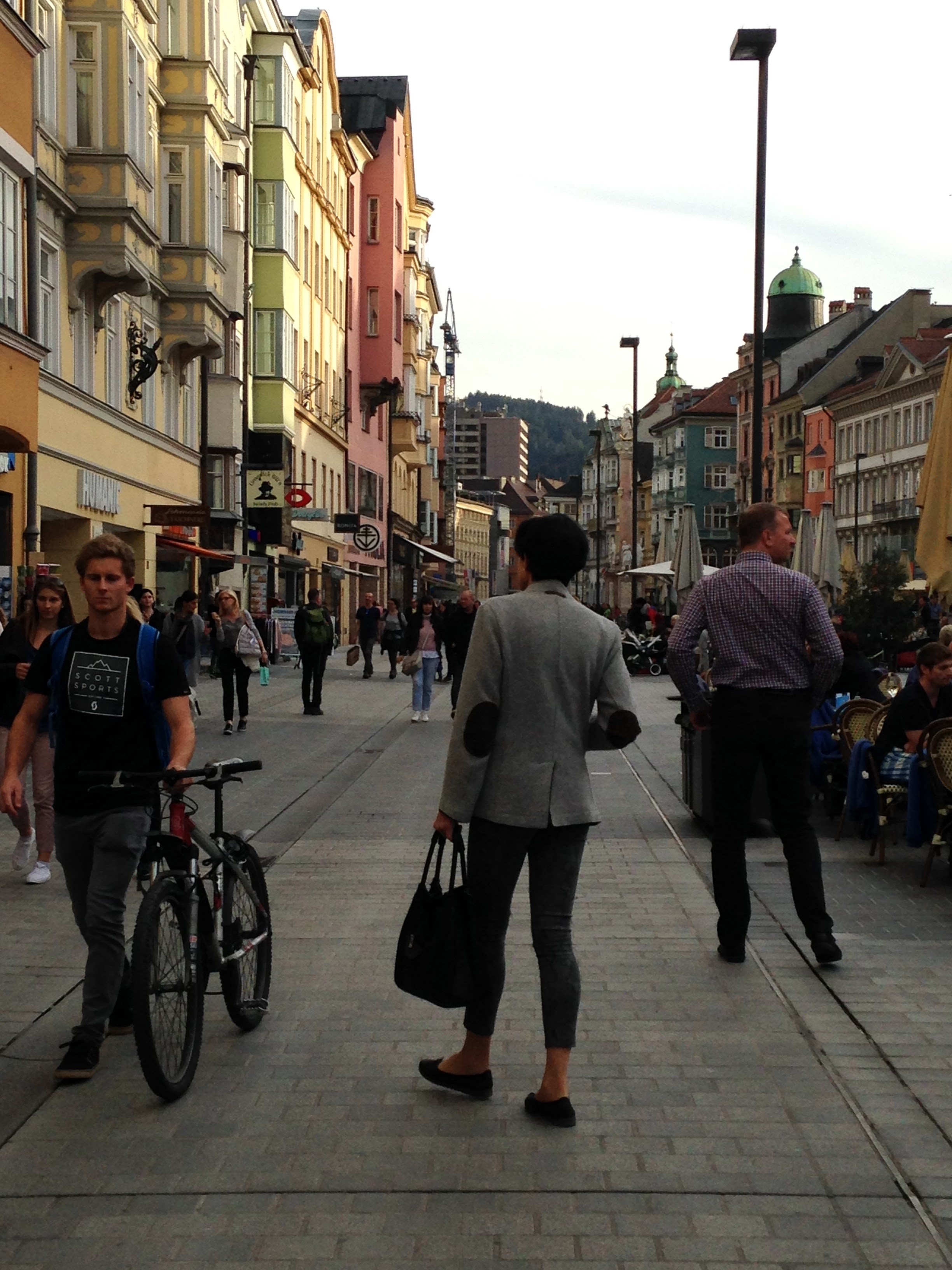
I strolled across the street to a pedestrian only plaza where shoppers and diners milled and mingled.

IMG_0400.jpg

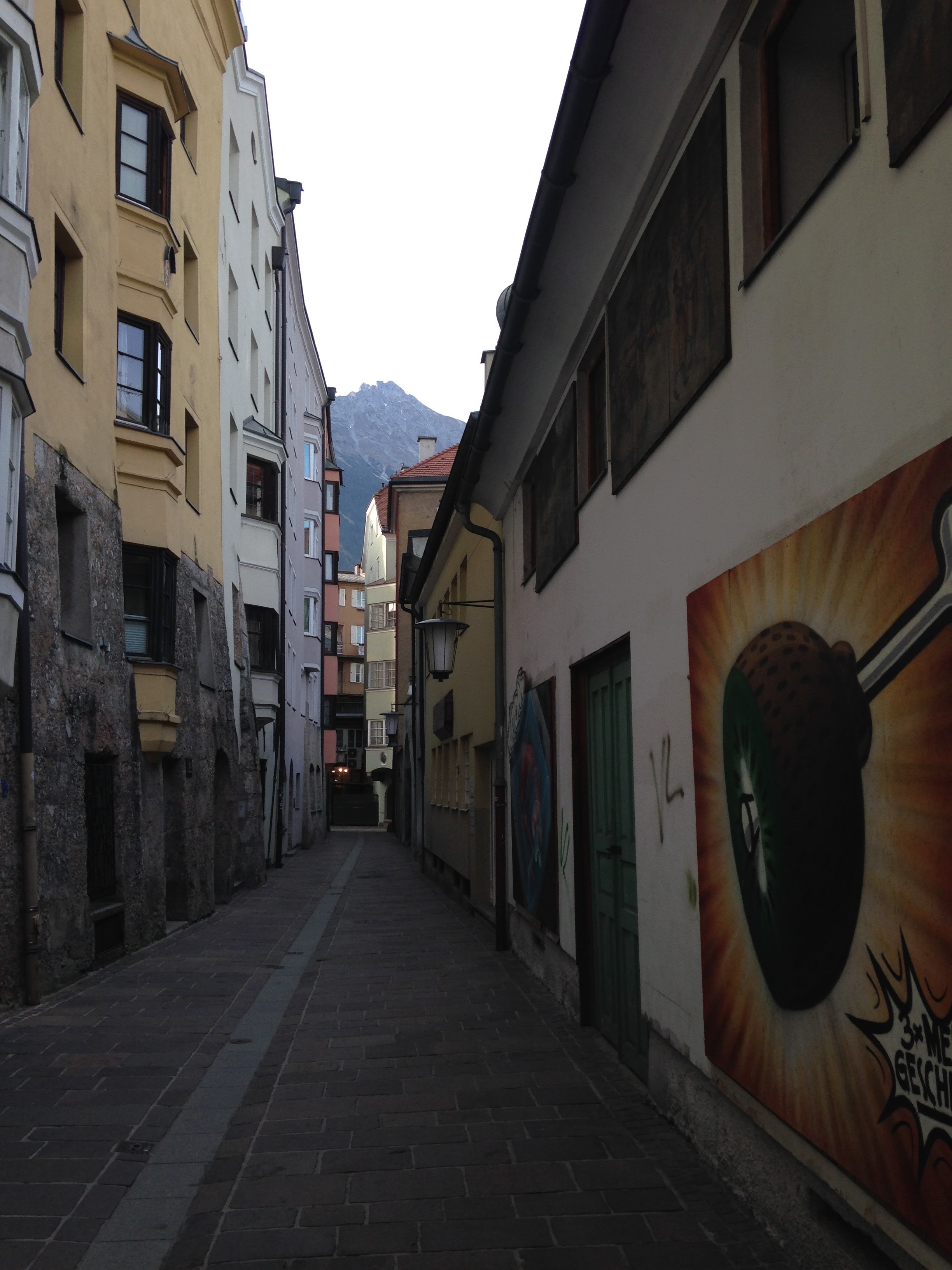
…before finding this strange alley of murals. That closest one is a kiwi on a chicken bone. Perhaps a show of peace among vegans and carnivores (although I’m doubtful).

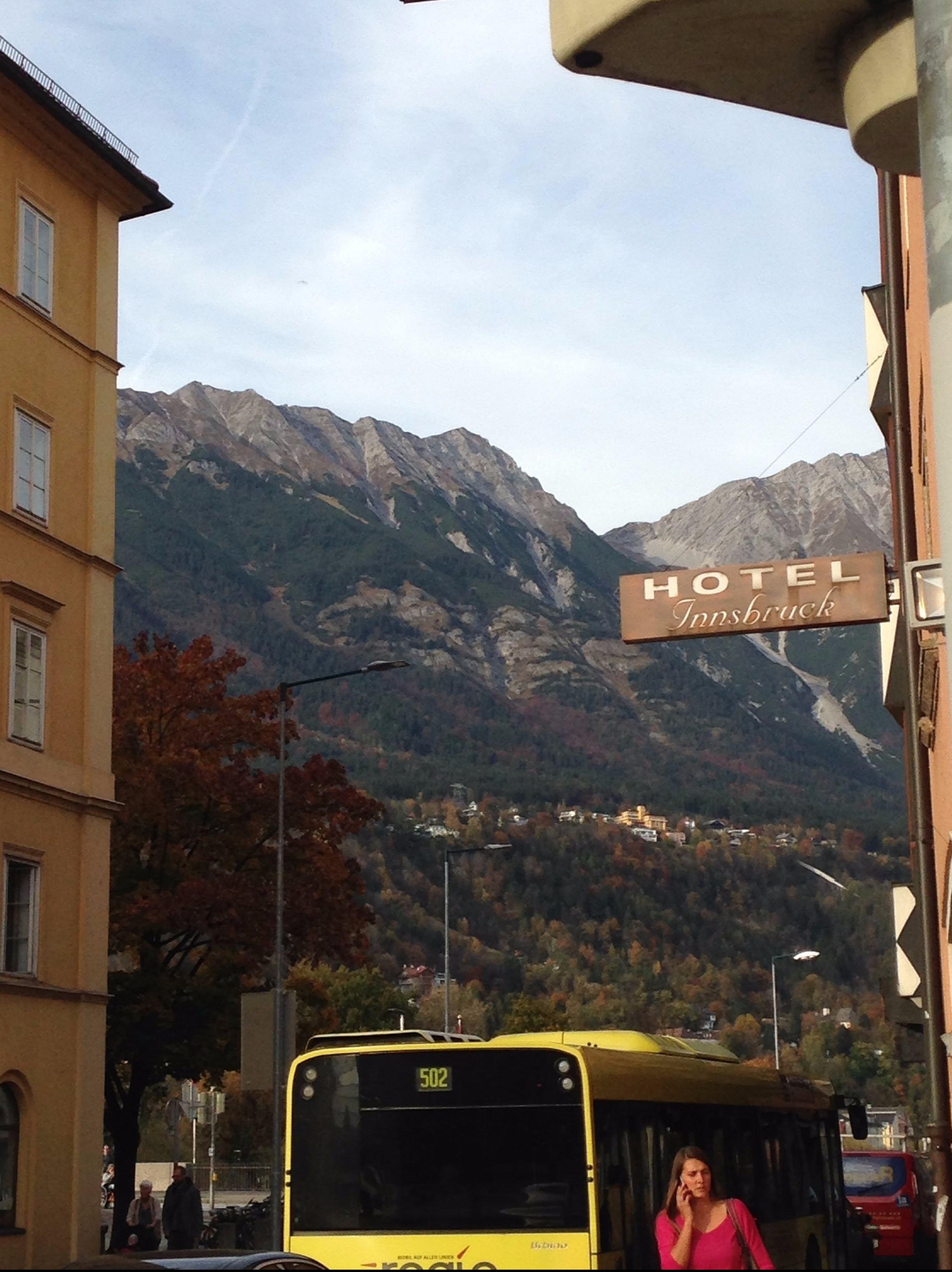
img_0402.jpg I didn’t stay at this hotel; I just took this picture to prove I was really in Innsbruck.
IMG_0438.jpg

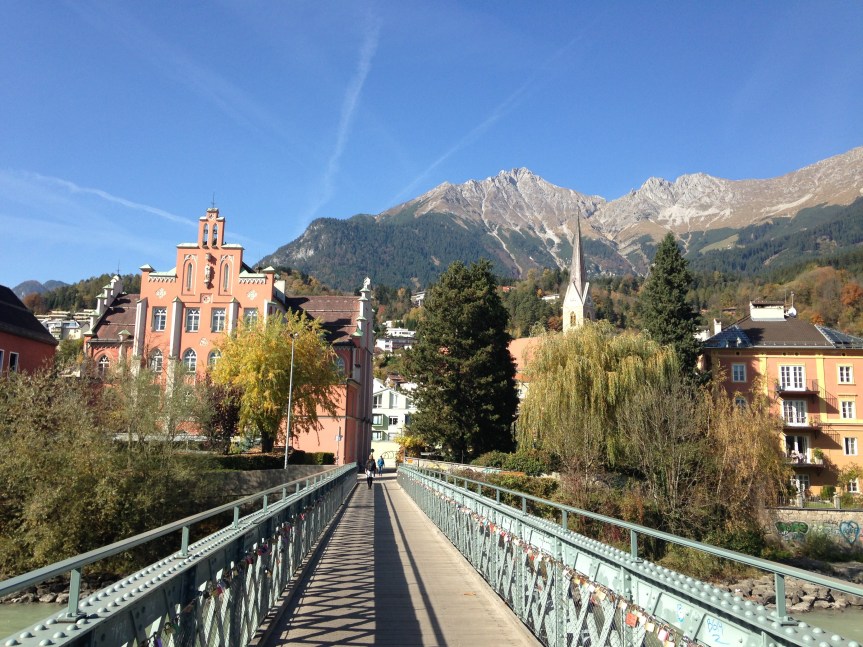
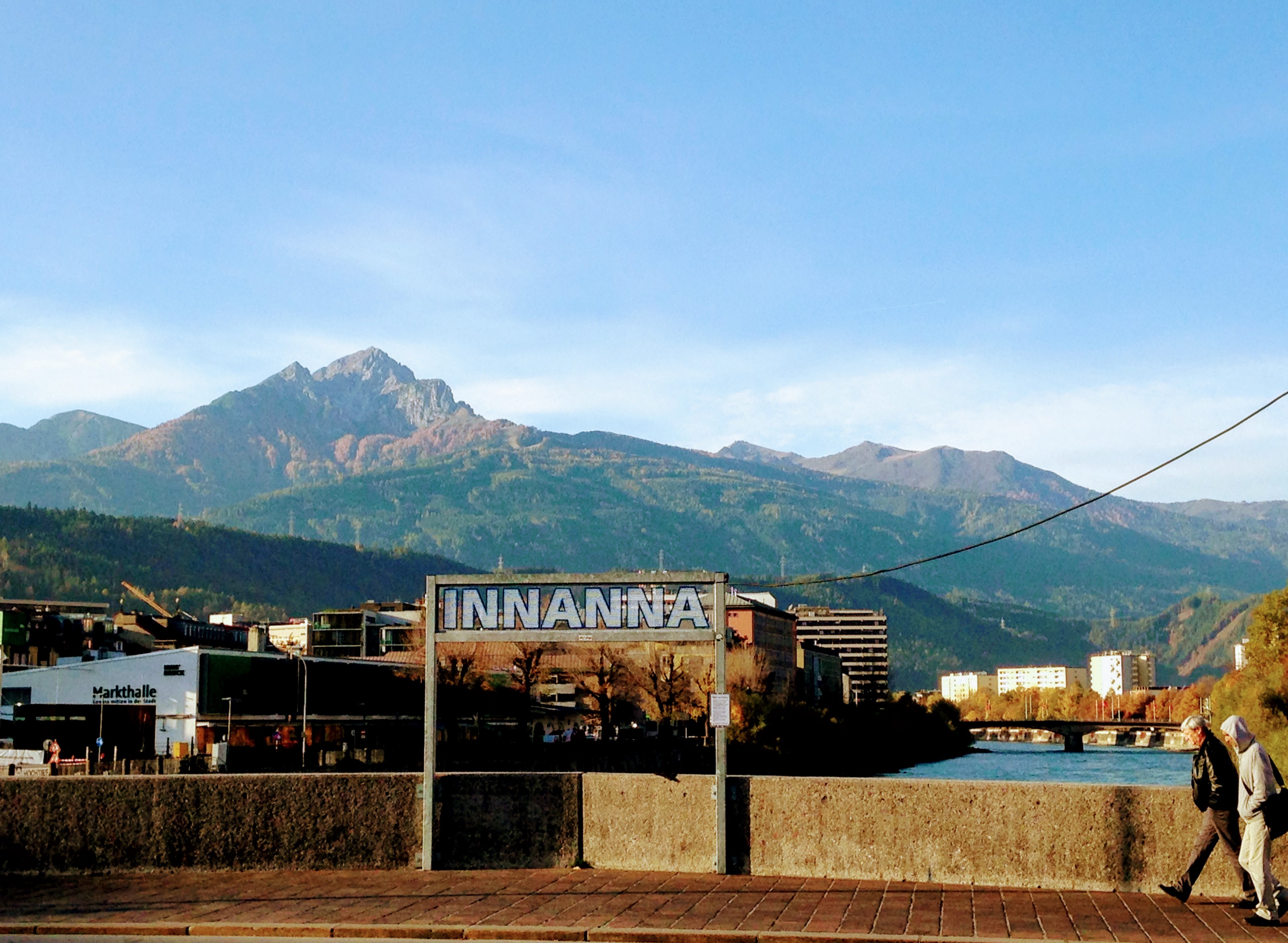
I walked across the bridge towards my new abode in the wake of mountains all around.

IMG_0409.jpg

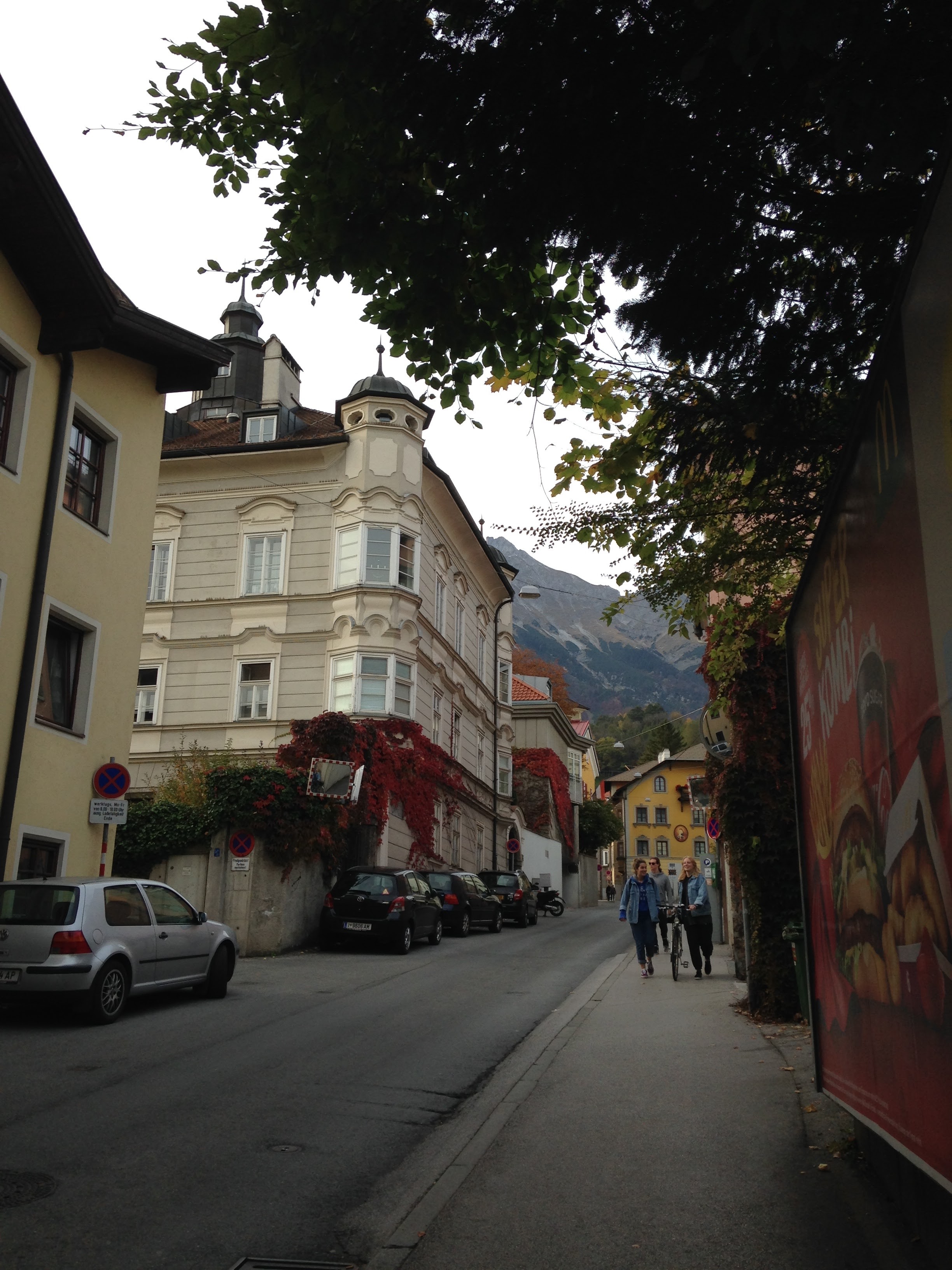
Et voila, practically home. The huge wooden door was tucked behind a swath of climbing red ivy between two classically Austrian buildings.

Everyone was walking or biking up and down the steep hills. In many places there were wide pedestrian sidewalks next to double-lane bike paths, bordered by a line of trees and flowers, before finally meeting the edge of a quietly buzzing road on which the motorists dutifully slowed on yellow and stopped on red.

It took me awhile (I mean like two weeks after I returned) to realize why I felt (at least in part) such a sense of peace in Innsbruck. It could have been the mountains all around or the fact that I was at a conference where everyone was thinking and talking obsessively about diabetes (just like me!), but another huge part of it was the pervasive walkability of the city. Pervasive because it was unavoidable – you couldn’t get where you needed to go without walking. It didn’t just feel safe to walk alongside the cars, but in many places there were no cars at all. The restaurant I ate at twice – Osterreich – which I actually thought had something to do with an Ostrich, before I realized how painfully complacent my brain was acting – was only accessible via foot. And, what’s more, the whole time you sat, enjoying grilled chicken or roasted sausages, fluffy piles of freshly grated horseradish, or mounds of sauerkraut, you could watch, not cars whizzing by, but a live feed of humans doing human things.

IMG_0475.jpgFor example, this brass band bedecked in green, who lined up to play in the heart of the city.
Walking is one of my favorite things. But also, walking is one of my favorite things about traveling. I’m grateful to have a car, but I don’t like cars. I like moving more slowly through life and having the chance, if I so choose, to reach out and touch it. And diabetes loves a walk. People talk about the benefits of exercise for diabetes management, as if exercise was some strange set of unnatural activities that the body must be guided through. I’ll admit, I go for a run every now and then, and it does bring my blood sugar down, but for me, there’s nothing like walking to bring my body into balance. Adam Brown, a writer often featured on diaTribe, explains the blood sugar benefits of walking beautifully here. When my bg is high, instead of dropping rapidly like I do while running, I glide towards a more reasonably blood sugar. Instead of tiring me out, a long walk makes me ready for another walk, or a night of dancing (lucky for me too, because of all the specialists, pediatric endocrinologists are the best dancers).

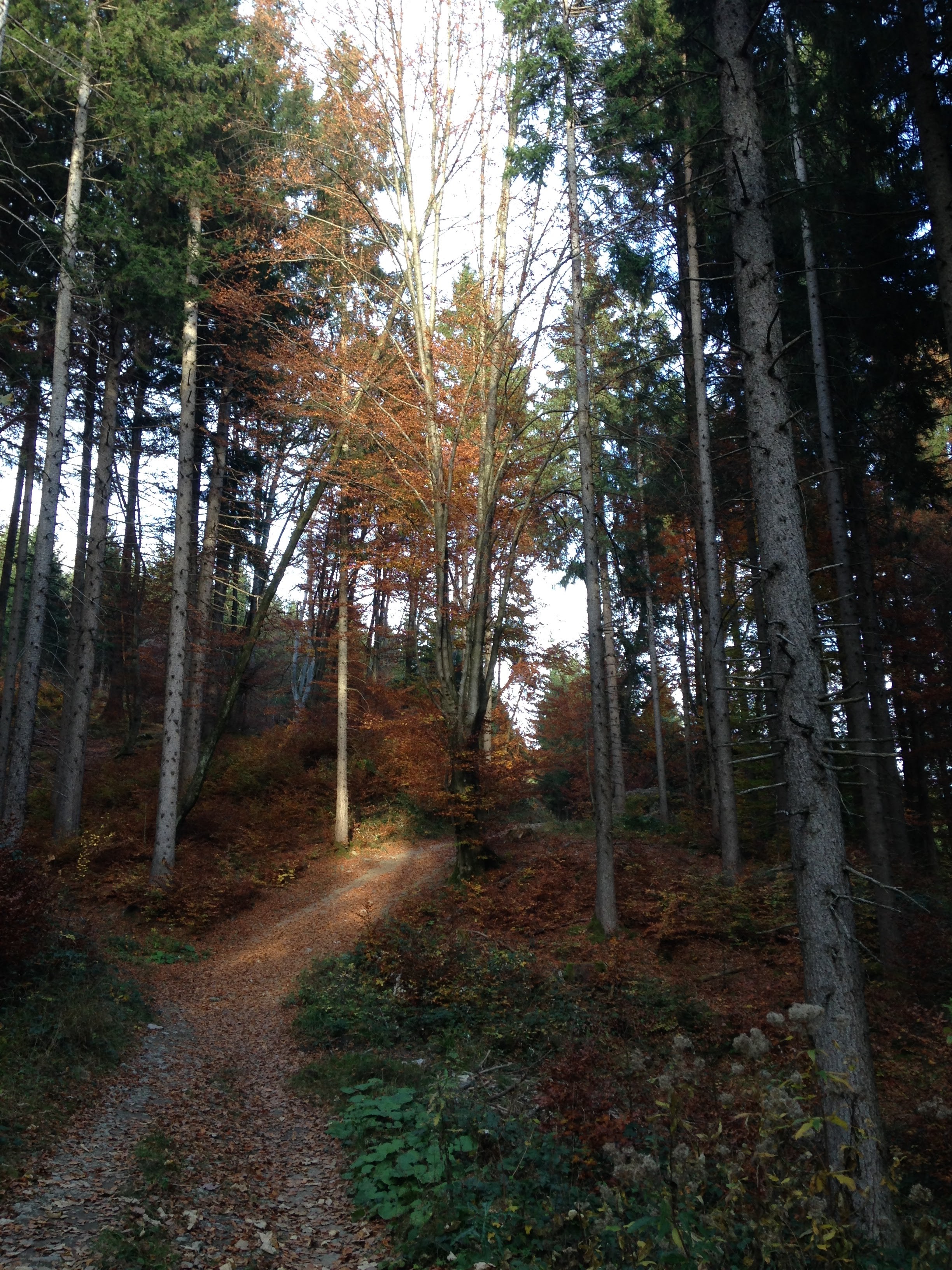
My last day in Innsbruck, after cramming my head full of presentations and standing up to do a couple myself, I took myself on a mind-clearing walk. My host had told me there was a tram to the top of the mountain, so I headed up the hill towards the peak. Shockingly, I did eventually find the tram, but then decided that my budget preferred continuing to walk. Oh also, that’s another thing, walking is cheap!

IMG_0491.jpg

Not to mention beautiful.

IMG_0487.jpg

Gazing out over Innsbruck, I felt overwhelmingly grateful for my experience and for all the people who helped me get there. Although I enjoy the feeling of solo exploration, traveling, more than anything else I think, makes our interconnectedness blazingly obvious. I was guided by countless mentors and passed from hand to hand of old and new friends on this journey. Thanks to each and every one.

Leaving Vienna in the morning

**Monday of this week was World Diabetes Day 2017, so in honor of all my diabetes sisters, brothers, and supporters, this post will offer a little more intimate look at the diadetails of my life than others.

After yoga Monday evening in Vienna, I followed a group of yogi/inis to a delicious dinner of Vietnamese food. Yes, definitely Vietnamese and not Viennese – although I would end up eating a lot of traditionally Austrian fare. I was just a little bit low by the time we arrived at the restaurant [70 mg/dl or so], which was really a pleasant surprise after battling some higher numbers on the sedentary plane ride. I ordered an ‘Elderberry Water,’ description in German, so I was taking a total leap. It was, in fact, an elderberry-infused glass of water – and totally delicious.

I also ordered several other things – Vietnamese crepes and spring rolls with interesting mayo-based sauces. As a lover of sauce I was delighted. I was also almost delirious from exhaustion, approaching the evening of the day that should have been a night, but it was wonderful to be sitting at a table with people living their lives in this new city I’d just stumbled in to.

That night, teeth brushed, ready to climb the ladder to my lofted bed, I found the walk back to the apartment could not compete with the long plane flight, screwed up schedule, and reduced control over food choices. Nevertheless, despite a blood sugar of 201 mg/dl, I took an extra shot and crawled happily into bed.

Every morning I wake up and check my blood sugar. Then, as my coffee is percolating, I take my shot – the same amount each morning unless something exceptional is happening that day. I have my first cup of coffee and plan the day while my insulin activates, so to speak. It’s a wonderful routine – a forced stillness and reflection courtesy of diabetes. When I awoke in Vienna to a dreamy light pouring into the vaulted living room, my blood sugar had evened out to some degree (mid-hundreds). I drank my coffee staring out onto the criss-cross of streets below and apartment windows across.

IMG_0367.jpg

Unless you have it, at this point you may need a diabetes glossary to understand a few concepts:

Walk competing with a plane ride…What?

Insulin activating…Hmm?

The day-to-day details of life with diabetes are heightened when traveling, precisely because of the exciting release of control that a good adventure requires. So at the same time that you’re sinking into the moment, diabetes can loom even bigger in the back of your mind. But I’ve learned, slowly, painfully over the years, to not let it steal the joy of the unknown from me.

A few ways I’ve successfully experienced this reclaiming of joy:

  • Allow myself a wider target range while traveling – if I’m not dropping dangerously low at night, I’ve succeeded! Likewise, as long as I can bring a high blood sugar down, things are fine. Interestingly, often this more ‘relaxed’ attitude brings with it surprisingly ‘good’ numbers.
  • Tin foil and plastic Ziplock bags at all time. How could a Ziplock bag improve my bg numbers while traveling? – you ask. Well, this may not be true for everyone, but I am the sort of person who doesn’t need to eat a whole treat to be satisfied, but who feels utterly denied if I can’t try a bite of something I’m offered. I don’t typically buy or order things that don’t support my blood sugar, but if they are there and free – I just gotta know. There are only a few exceptions I turn my nose up at completely (likelihood increases if said ‘food’ is enveloped in sealed plastic). So if I get a treat while traveling, say a flakey pastry pinwheel like they displayed on small square, porcelain plates at the conference during coffee breaks, I have a delicious bite (sometimes two) and pop it in the bag. Although often I throw away the remains before completely consuming it, it’s still less waste overall because one treat extends over a whole day, or sometimes even two or three (remember to refrigerate when necessary)!
  • And let’s talk about refrigeration. I always arm myself with a doctor’s note before traveling that states that I will be traveling with my medications and that they will need to stay cool. Perhaps because of this, or maybe my medical id bracelet (also essential when traveling alone), or because I am open about proclaiming my diabetes in airports, I have always been able to carry a little cooler with me without being stopped for having what is technically an ‘extra’ carry-on bag. I never let this cooler out of my reach – not to put it in overhead bins and definitely not to check it. I’m curious if others with T1D have successfully traveled with small coolers. Mine is soft and I use a little tiny icepack – which does flag the security scanners sometimes. Both times this has happened I have been cleared to continue on my merry way.

My diabetes travel guidelines in summary:

  • Be kind to myself, aka loosen up
  • Carry Ziplock bags or tinfoil
  • Be open/up front about diabetes

I packed a yogurt in my icepack for my four-hour train journey to Innsbruck, during which I would retrace on the ground the route I had flown the previous day. I jostled back in forth from one side of the train to the other trying to catch views of mountain peaks and aquamarine waterways, before finally being lulled into a nap by the hum of the rails.